
Food Is Part of the Trip
Sri Lankan food is not well known internationally, which works in your favour: you arrive without fixed expectations and discover a cuisine you arrive at without the fixed expectations that follow better-known cuisines. The flavours are built on coconut, chilli, and a specific set of spices that are not the same as Indian curry blends, even though the two traditions share common roots. The food is different at the coast, in the hill country, and in the north, and it changes further depending on whether the cook is Sinhalese, Tamil, or Muslim Sri Lankan.
This guide covers what to eat, how meals are structured, the street food scene, and the tea culture that defines the hill country.
Rice and Curry: The Foundation of Every Meal

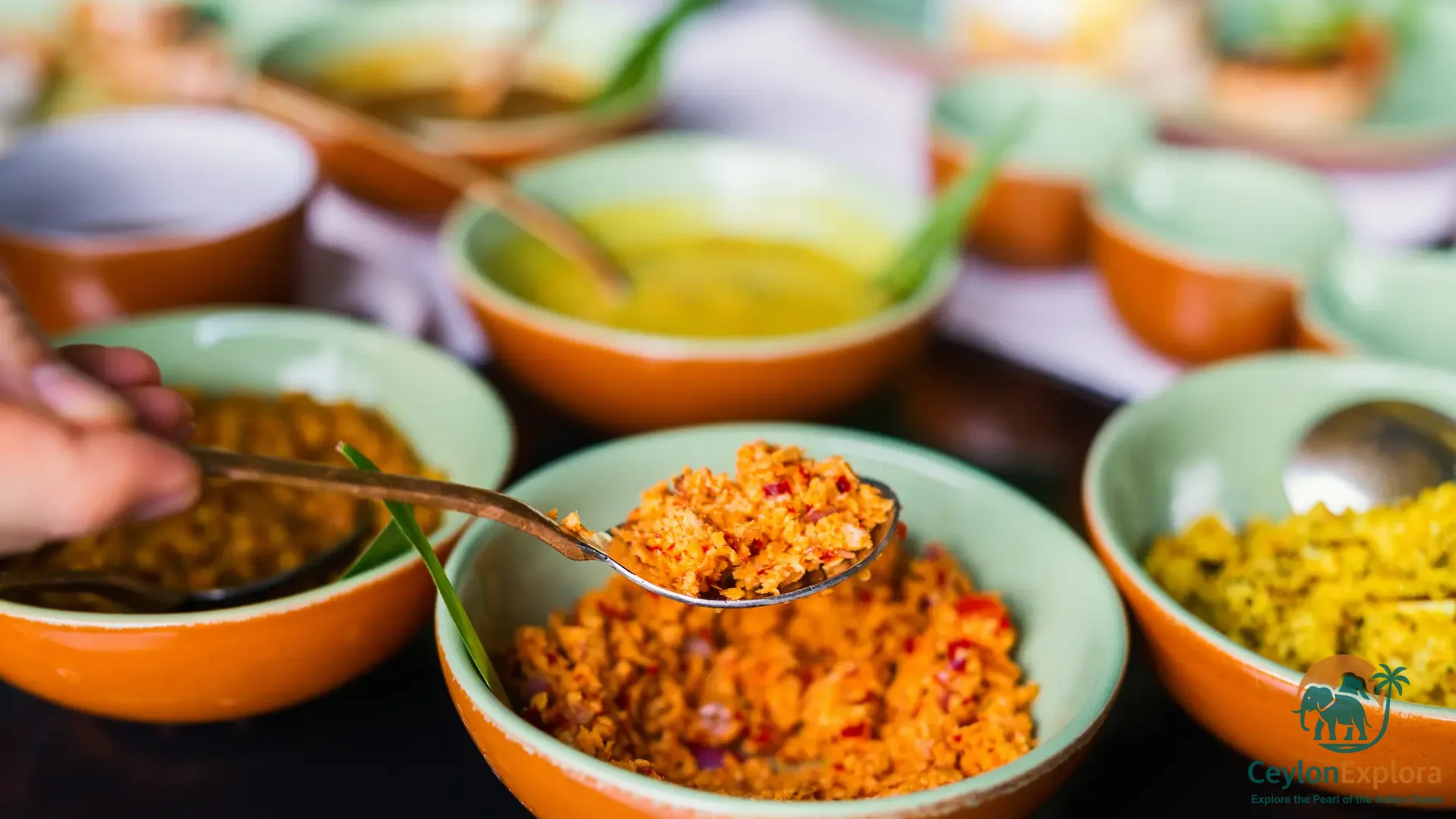
A Sri Lankan meal is not "rice with a curry." It is rice surrounded by a collection of curries and condiments, typically four to six small dishes arriving together: a dhal (lentil) curry, a vegetable curry, a fish or meat curry, a coconut sambol, and often a mallum (wilted greens dressed with coconut and lime). You eat them together, mixing as you go.
The rice is usually white or red (red rice is more nutritious and slightly nutty), and the curries are served in small portions around it. In local restaurants and homes, this meal arrives on a banana leaf or a large plate, and you use your right hand to eat. If you are eating at a local "rice and curry" restaurant rather than a tourist establishment, expect to spend between LKR 300 and 700 (about $1 to $2.50) for a full meal.
The core spice ingredients in Sri Lankan curry differ from Indian blends: roasted and ground curry leaves, pandan leaf, goraka (a souring agent made from the dried rind of Garcinia cambogia, also called Malabar Tamarind), fenugreek seeds, and fresh coconut milk give the flavours a distinctly Sri Lankan character. "Black curry" (where spices are dry-roasted before grinding) and "white curry" (where coconut milk is added early and spices are not roasted) are the two main cooking styles, and both appear on a typical rice and curry spread.
Hoppers: Bowl-Shaped Breakfast and Evening Food

An appa (hopper) is a small bowl-shaped pancake made from a fermented batter of rice flour, coconut milk, and coconut water. The batter ferments overnight, which gives the hopper its slightly sour flavour. The outside edge is thin and crispy; the centre is thick and soft. It cooks in a small wok in about two minutes.
The egg hopper is the most common version: an egg cracked into the centre while the hopper is still in the pan, cooking to a soft-set yolk surrounded by the rice batter. Hoppers are served with coconut sambol (freshly grated coconut with lime, dried chilli, and red onion), dhal curry, and seeni sambol (caramelised onion relish).
Hoppers are breakfast or evening food in Sri Lanka. At hotels they appear at the breakfast buffet; at local hopper stalls they are served from about 6pm as the evening starts. If you find a roadside hopper stall busy with locals, that is the one to eat at. A plate of two egg hoppers with accompaniments costs around LKR 150 to 300 ($0.50 to $1).
String hoppers (idiyappa) are different: pressed rice flour noodles steamed into flat rounds. They are gluten-free, very mild, and are typically eaten at breakfast with dhal curry and coconut milk.

Kottu Roti: The Sound of Sri Lankan Street Food

If you walk through a Sri Lankan town after dark, you will hear kottu before you see it: a loud, rhythmic metal-on-metal chopping sound from the griddle. Kottu roti is made by taking a thin flatbread (godamba roti), chopping it into small pieces on a hot iron griddle using two metal blades, and mixing it with vegetables, egg, and your choice of meat or seafood, all cooked together with spice paste and curry gravy.
The result is a hot, satisfying, slightly greasy plate of food that makes perfect sense at 9pm after a day of walking. It comes in chicken, beef, seafood, cheese, and vegetarian versions. A plate typically costs LKR 400 to 800 ($1.50 to $2.50).
Good kottu is available at road-side stalls in every tourist town: Colombo's Pettah market area, Hikkaduwa beachfront stalls, Kandy's street food strip near the lake, and Ella's main road all have reliable options. The quality at a busy roadside stall is almost always better than at a restaurant that lists it on a menu as an afterthought.
Seafood on the Coast

Sri Lanka is surrounded by the Indian Ocean, and the fresh seafood at coastal restaurants is a strong reason to eat by the water rather than in town. Catches vary by season and by region, but you will typically find:
Crab: Sri Lankan lagoon crab, cooked with black pepper or chilli, is regarded as some of the best available in South Asia. Order it at Colombo's seafood restaurants (particularly in the Mount Lavinia area) or at lagoon-side spots near Negombo and Jaffna
Prawn and lobster: Fish and prawns freshly grilled at beach restaurants vary widely in price; ask the daily rate before ordering
Ambul thiyal (dry fish curry): A southern speciality where fresh tuna is cooked with goraka (the Malabar Tamarind souring agent) and black pepper until almost completely dry. The goraka and the reduction process preserve the fish without refrigeration, which matters in coastal heat. It is intensely flavoured and worth ordering at any southern Sri Lankan restaurant
Devilled dishes: A Sri Lankan cooking style (distinct from Indian) where seafood or chicken is stir-fried in a wok with onion, capsicum, tomato, and chilli until semi-dry. Devilled prawns and devilled cuttlefish are popular tourist orders
Coconut and the Spice Backbone

Almost every Sri Lankan dish uses fresh coconut in some form: coconut milk in curries, grated coconut in sambols, coconut oil for frying, coconut flour in some roti. The coconut palm grows across the island at lower elevations and supplies a significant portion of the local diet.
Key ingredients worth knowing by name when ordering or visiting markets:
Pol sambol: Freshly grated coconut with dried chilli, lime juice, and red onion. It accompanies nearly every meal and is almost always made fresh
Goraka (gamboge): A dried souring fruit used in place of tamarind in southern Sri Lanka; it appears in fish curries and some meat dishes
Pandan leaf (rampe): Adds a grassy, slightly sweet note to rice and coconut milk curries
Maldive fish: Sun-dried and cured tuna, shaved and used as a seasoning in many sambols and some curries. It is what gives pol sambol its depth in traditional recipes
Street Food Worth Finding

Beyond kottu and hoppers, a few other street foods are worth tracking down:
Isso vadai: A lentil and rice flour fritter with a prawn pressed into the top, deep-fried. Sold at roadside stalls near Colombo's Galle Face Green and at bus stations across the island. Around LKR 50 to 80 each
Roti (godamba roti): Thin, slightly flaky flatbread cooked on a griddle, eaten plain with curry or filled with egg, cheese, or banana for a sweeter version. LKR 100 to 200
Watalappan: A coconut milk pudding set with jaggery (palm sugar) and cardamom, from the Muslim Sri Lankan community. Found at Muslim-run bakeries and some restaurants; rich and dense, similar to a firm panna cotta
Wood apple (Divul) juice: A thick, tart drink from the wood apple fruit, commonly sold from roadside stalls in season. Polarising flavour: some people love it, some do not. Try it once
Short eats: Sri Lankan pastries sold at bakeries: fish or egg rolls (a thin pastry filled and deep-fried), patties, and cutlets. Common grab-and-go food at bus stations. Around LKR 50 to 100 each
Where to Eat
Three types of eating establishments cover most situations:
Local "rice and curry" restaurants: Unlabelled plastic-table spots that serve a set meal of rice plus whatever curries were cooked that day. No menu, no English, often no sign. You sit down, a plate arrives. These are where locals eat and where the food is most authentic. LKR 300 to 700 per person
Tourist restaurants: Found on main streets in Ella, Mirissa, Galle, and Kandy. They serve Sri Lankan dishes alongside Western food and usually have English menus with photos. Food quality varies; prices run two to four times local rates. Useful for a comfortable first meal or when you need wifi and an hour to plan
Hotel breakfast buffets: Sri Lankan hotels of any mid-range standard put on morning spreads that include hoppers, string hoppers, dhal, sambol, fried rice, and fruit. If your accommodation includes breakfast, it is usually the best and easiest introduction to local food
Colombo has a serious restaurant scene if you arrive or depart through the capital: crab at Ministry of Crab (specialist mud crab restaurant at the Old Dutch Hospital complex, book ahead), seafood at the Mount Lavinia Hotel beachfront, and short eats at Hotel de Pilawoos, 417 Galle Road, Kollupitiya (Colombo 3), open 24 hours.
Ceylon Tea: A 150-Year Industry

Sri Lanka produces some of the most traded tea in the world, and the industry has direct roots in British colonial agriculture. In 1867, Scottish planter James Taylor planted the first commercial tea crop at the Loolecondera estate near Kandy, as a fungal disease (Hemileia vastatrix) began destroying Ceylon's coffee plantations; by the 1880s, coffee production had collapsed entirely. By 1873, Taylor had sent the first consignment of Ceylon tea to London, 23 pounds in total. The first formal sale at the London Tea Auction followed in 1875. By 1899, tea plantations covered nearly 400,000 acres of the central highlands.
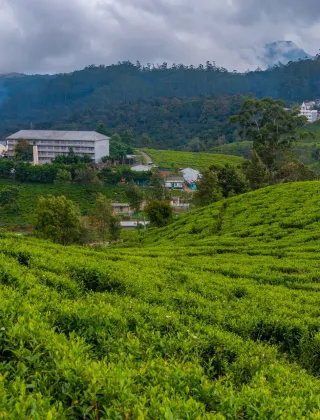
Today, Sri Lanka is typically the world's third or fourth largest tea exporter by volume, generating over USD 1.3 billion in annual export earnings and remains one of the primary sources of employment in the hill country regions. The vast majority of Sri Lankan tea is grown between 600 and 2,200 metres of altitude in the central highlands: Nuwara Eliya, Dimbula, Uva, and Kandy are the main growing districts, each producing tea with distinct flavour profiles.
Types of Ceylon Tea
High-grown (above 1,200 metres): Light, delicate, and highly aromatic. Nuwara Eliya teas are in this category: described as the "champagne" of Ceylon teas in the trade, with a brisk, bright flavour and golden colour
Mid-grown (600 to 1,200 metres): Fuller-bodied with a rich colour. Kandy district teas fall here
Low-grown (below 600 metres): Strong, dark, and bold. Used primarily in blends and in the export tea bag market
Visiting a Tea Factory
Most working estates in Nuwara Eliya and Ella offer factory tours. You walk through the withering loft (where freshly picked leaves are spread on mesh trays for 12 to 16 hours to reduce moisture), the rolling room (where the leaves are twisted to break cell walls and release flavour), the fermentation room (where oxidation changes the leaf from green to copper), and the drying room (where the leaf is dried at 100 to 120 degrees C to arrest oxidation).
The tour typically ends with a tasting. The Pedro Estate and Mackwoods Labookellie estate in Nuwara Eliya both offer free tours with tea tasting included. In Ella, several smaller estates offer guided visits for around $3 to $5 per person.
If you want to take tea home, buying directly from the estate or from a reputable tea shop (Mlesna and Dilmah are the two most widely distributed Sri Lankan tea brands internationally) gives better quality than airport duty-free shops, which often stock lower-grade or older stock.
Practical Food Tips
Sri Lankan food is spicy by default. If you want a milder version, say "less chilli" when ordering. Most cooks will adjust
Tap water is not safe to drink. Bottled water is available everywhere for around LKR 50 to 80 per bottle
Vegetarians eat well in Sri Lanka: the local Buddhist tradition means vegetable curries are central to the cuisine, not an afterthought. Many local restaurants are entirely vegetarian or have extensive vegetarian menus
Pork is rarely served and not always available, particularly in areas with large Muslim populations (Colombo's Pettah, the east coast, parts of the north)
The Muslim community's food (particularly in Colombo and the east coast) has its own distinct style: biriyani, mutton rolls, and watalappan are worth seeking out in Muslim-run restaurants and bakeries
Fruit is excellent year-round: seasonal mangoes, pineapple, papaya, rambutan, mangosteen, and wood apple. Buy from roadside stalls for the freshest and cheapest options
Want to Build a Food-Focused Itinerary?
A tour built around food and tea makes sense as a standalone focus or woven into a broader trip: a cooking class in Galle, a tea factory visit in Nuwara Eliya, a morning market walk in Kandy, and a seafood dinner at a southern coast lagoon. The team at CeylonExplora can put together a route that includes the food experiences you want without sacrificing the headline sites. Get in touch to discuss your trip.
From Fellow Travellers
Comments
No comments yet
Been here, or planning your own trip? Share your experience below and help the next traveller.
Leave a Comment
Comments are reviewed before publishing. No links, please. Email is optional and never shown.