
Kandy Esala Perahera 2026: Dates, Schedule and Visitor Guide
Sometime around 8pm on an August night in Kandy, the first whip-crack cuts through the noise of tens of thousands of people packed along the route. Then a second. Then a cannon fires. The sound rolls off the surrounding hills. When it settles, the first hewisi drummer appears at the head of King Street and the procession begins to move.
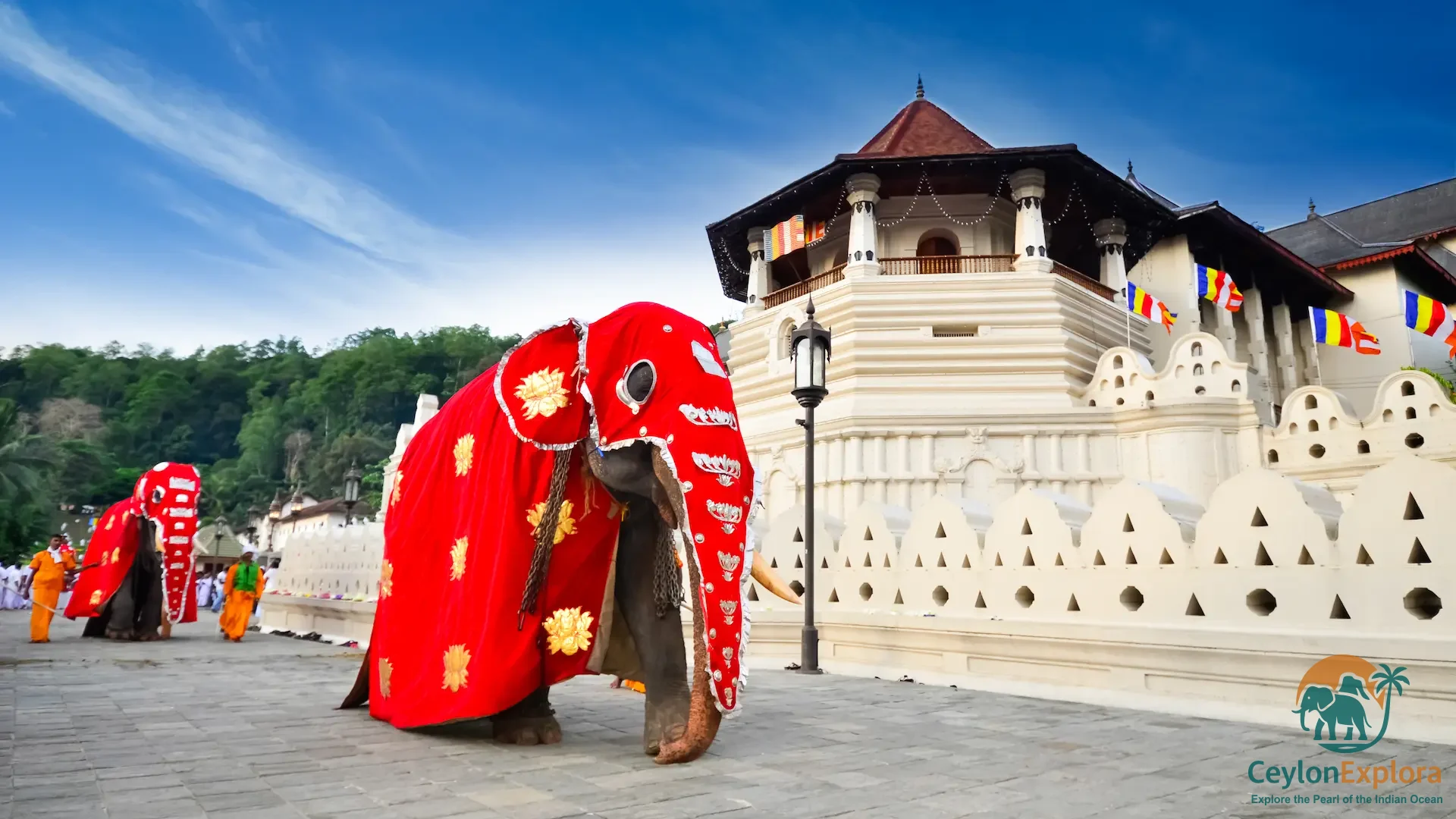
The torchlight arrives before almost anything else: a line of bare-chested fire-bearers walking the centre of the road in bare feet, each carrying a long pole capped with a metal cage packed with burning coconut husks soaked in kerosene. The smell — kerosene, charred copra, the sweetness of burning coconut fat — reaches the crowd before the procession itself. By the time the hundred-plus elephants have passed your position, the street sits under a low haze of torch smoke that gives the whole spectacle a quality no photograph fully captures.
The Kandy Esala Perahera is Sri Lanka's largest annual festival and one of the most significant Buddhist cultural events in South Asia. In 2026, the public street processions run from August 18 to August 27, with a daytime closing ceremony on August 28.
One Thing Most Guides Get Wrong
The festival centres on the Sacred Tooth Relic of the Buddha, enshrined at the Sri Dalada Maligawa (Temple of the Tooth) in Kandy. Most tourist content describes it as a procession of the relic itself. This is not accurate, and the distinction matters.
The actual relic does not leave the temple. It remains sealed inside multiple nested golden caskets in the inner sanctum and is never moved. What the Maligawa Tusker carries is the Perahera Karanduwa, a replica of the relic casket, mounted under an ornate gilded ransivige (a domed canopy frame) secured to the elephant's back. The Karanduwa is a sacred object in its own right, and its approach is marked by a change in the drumming tempo. When it passes, many Sri Lankan spectators sitting on the roadside spontaneously sit cross-legged and bow in a collective, unrehearsed mark of reverence. Visitors who know to watch for this moment often describe it as the most affecting part of the entire night.
One more thing no guide adequately warns you about: the Maligawa Tusker and the relic casket travel near the middle to rear of the full procession. The opening performers — whip-crackers, flag-bearers, initial drummers, early devala contingents — can take two hours to pass. Tourists who arrive late or leave early frequently miss the centrepiece of the event entirely.
2026 Festival Dates
The festival is named after the Esala lunar month in which it begins. In 2026, the Esala full moon (Poya) falls on July 29. The public street processions do not start until three weeks later. Any guide citing July 29 as the festival start in 2026 is wrong. The festival concludes on the Nikini Poya, August 27.
Kap Situveema (opening ritual): approximately August 12–13. A sanctified jackfruit sapling is planted within each devala's grounds, formally opening the festival. This is a ritual ceremony, not a public street event.
Internal Devale Peraheras: August 13–17. Each of the four devala shrines holds its own procession within its own grounds. These are religious observances, not tourist spectacles.
Kumbal Perahera — nights 1 to 5: August 18, 19, 20, 21, 22.
Randoli Perahera — nights 6 to 10: August 23, 24, 25, 26, 27.
Diya Kepeema (water-cutting): August 27 morning, at the Mahaweli River in Getambe. A ritual closing ceremony that precedes the final Randoli night procession.
Dahawal Perahera (Day Procession): August 28, approximately 2:00–4:00 pm.
The Structure of the Procession

The festival has two distinct phases. The Kumbal Perahera (nights 1–5) is the smaller-scale opening phase: approximately 50 to 60 elephants, a shorter procession column, and significantly lower crowd density. "Kumbal" refers to an earthen pot, reflecting the simpler symbolic register of the early festival phase. These nights are genuine and impressive. They are also far easier to attend without a premium gallery ticket or an early-morning arrival to hold a street position.
The Randoli Perahera (nights 6–10) is the grand phase. Elephant numbers climb to 100 or more. "Randoli" refers to the royal palanquins now added to each devala's contingent, symbolically carrying the queen consorts of the presiding deities. The full combined column can stretch over a kilometre. At a fixed viewing point, it takes four to five hours to pass from first performer to last elephant.
The Maligawa (Temple of the Tooth) procession leads the column. Behind it, in a fixed order that has not changed since 1775, come the four devala processions:
Natha Devale — representing Natha Bodhisattva, the future Buddha and principal guardian deity of the island. The Natha Devale, directly opposite the Sri Dalada Maligawa, is the oldest surviving building in Kandy, dated to the 14th century.
Vishnu Devale — the Hindu preserver deity, venerated in Sri Lankan Buddhism as the guardian and protector of the island and the Buddha's teaching.
Kataragama Devale — dedicated to Kataragama Deviyo, identified with the warrior deity Skanda. The procession includes Kavadi dancers carrying large semi-circular wooden frames adorned with peacock feathers.
Pattini Devale — the goddess of healing, chastity, and protection from disease. The only procession to include female dancers.
The combined hewisi ensemble — gatabera drums, tammettam drums, horanewa pipes — produces sound that is physically felt as much as heard at street level. First-time visitors are consistently surprised by the volume and the resonance it carries through the road surface.
The Maligawa Tusker
The current lead tusker is Indi Raja, donated to the Sri Dalada Maligawa as a gift from the Indian government in 1988 or 1989 (the name reflects his Indian origin). He was elevated to chief casket bearer following the death of his predecessor, Nadungamuwa Raja, who died in March 2022. Nadungamuwa Raja served as lead tusker from 2005 to 2021, stood approximately 3.2 metres at the shoulder, and is widely described as having been one of the tallest elephants in Sri Lanka. A reconstructed replica of his preserved body opened at the Colombo Natural History Museum in June 2026. The most famous predecessor, Maligawa Raja, carried the casket for 37 years until 1988; his preserved body is displayed at the Sri Dalada Maligawa museum.
Gallery Seats vs. Free Viewing — The Honest Assessment
Free roadside viewing is available at every point along the 3 km route, and thousands of Sri Lankans watch from the pavement every night. It costs nothing. It is also significantly more physically demanding than most guides describe.
On Randoli Perahera nights, local spectators begin occupying pavement positions from mid-morning. By midday on peak nights, the best ground-level spots along Dalada Veediya and D.S. Senanayake Veediya are already held. By the time road closures come into effect in the early afternoon (from around 3:00 pm in 2024, from around 5:00 pm in 2025 on peak nights), the entire route is a continuous wall of people. Navigation through the Kandy city centre on these evenings is genuinely difficult — pavements are blocked, side streets near the route are impassable, and if you do not have a fixed seat or a position you secured hours earlier, you may find yourself unable to reach the route at all.
If you plan to watch from the roadside, treat it like a long day commitment on Randoli nights. Arrive by midday. Bring water, food, a compact mat or cushion, and a poncho — August is the inter-monsoon period and showers can be sudden and heavy. The reward for this commitment is real: elephants pass within arm's reach of street-level viewers, and the full sensory experience — the drums, the fire, the smell — is more immediate from the pavement than from any elevated gallery seat.
Gallery seating is the practical option for most international visitors who cannot commit to a full-day wait. Elevated gallery seats offer unobstructed sightlines, a fixed position, and the ability to arrive in the afternoon rather than at dawn. Gallery seats along the route are managed by private operators who lease building frontage from property owners; pricing is unregulated. Expect to pay approximately USD 80 to 110 per person depending on the night and location (Kumbal nights are cheaper than Randoli, and the final Randoli nights are the most expensive). These are commercial prices, not fixed government rates. The sole Sri Lanka hotel sitting directly on the procession route is Queens Hotel (No. 4, Dalada Veediya), 150 metres from the temple entrance — the best viewing position in the city, with balcony and window seats managed by the hotel directly.
Booking with Ceylon Explora
If you are planning a Sri Lanka trip around the Esala Perahera in August 2026, Ceylon Explora handles the parts that are hardest to arrange independently: gallery seats or balcony-view accommodation directly on the route, pick-up and drop-off from outside the traffic restriction zone, and a full Kandy itinerary built around your chosen nights.
Because accommodation on and near the procession route sells out six to twelve months in advance for Randoli nights, and because gallery ticket pricing and availability change every year, working with us early is the practical approach. Contact us at hello@ceylonexplora.com or via WhatsApp at +94 71 777 7558.
If you prefer to book independently, the legitimate paths are: direct booking with Queens Hotel for rooms with Perahera-night balcony access, or mytickets.lk (Sri Lanka's national ticket platform, which requires passport or NIC number at checkout). Be cautious of the many near-identical commercial domains that exist in this market — verify that what you are booking corresponds to a real seated position on the actual route before paying.
Planning Checklist
Which night: If attending one night, the final Randoli Perahera on August 27 is the largest. August 26 is nearly as grand with slightly fewer crowds. For first-timers who want a full experience without the maximum crowd, the first two Randoli nights (August 23–24) are the practical recommendation. Early Kumbal nights (August 18–20) are the best option if you dislike large crowds entirely.
Accommodation: On-route accommodation (Queens Hotel) and central Kandy hotels book out for Randoli nights six to twelve months in advance. If you have not booked by the time you read this, the budget alternative is staying in Peradeniya or Katugastota (5 to 15 minutes from the city centre) and entering on foot early.
Arrival: For free street viewing on Randoli nights, be in position by midday. For gallery seats, arrive at your seat location by 2:00–3:00 pm before road access closes. Do not plan to drive or take a tuk-tuk to the central viewing area after midday on peak nights.
What to bring: Water and food for a 5–8 hour wait. A rain poncho (not an umbrella in a dense crowd). A small cushion or mat. Modest dress: cover shoulders and knees as a mark of respect for the religious context.
Photography: Cameras permitted. No flash — it startles elephants and is disrespectful near the relic casket. Drones are prohibited without official media accreditation. A telephoto lens is useful for close-up shots from gallery distance.
The relic casket: The Maligawa Tusker and the Perahera Karanduwa appear near the middle to rear of the procession, not at the front. Wait for it. The drumming changes tempo when it approaches.
A Festival 1,700 Years in the Making
The procession's origins predate Buddhism in Sri Lanka. The Esala rain rite goes back to at least the 3rd century BCE, rooted in agricultural ceremonies addressed to local guardian deities during the reign of King Devanampiya Tissa. The Tooth Relic arrived in Sri Lanka around 310 CE, brought from Kalinga (eastern India) by Princess Hemamala, who concealed it in her hair during the journey. King Kithsiri Meghavana in Anuradhapura received it, enshrined it, and initiated the first Dalada Perahera in its honour, merging it with the existing Esala rite.
For the centuries that followed, controlling the relic meant legitimacy as the rightful ruler of the island. When the Kandyan Kingdom became the last sovereign Sri Lankan state, the relic moved with the court and the Dalada Maligawa in Kandy became its permanent home. The current combined structure of the festival — the four devala processions joining the Maligawa column in a single unified spectacle — was formalised in 1775 by King Kirthi Sri Rajasinha as a deliberate act of integration between the island's Buddhist majority and its Hindu communities. That structure has run continuously for approximately 250 years and remains unchanged today.


From Fellow Travellers
Comments
No comments yet
Been here, or planning your own trip? Share your experience below and help the next traveller.
Leave a Comment
Comments are reviewed before publishing. No links, please. Email is optional and never shown.