

What Kandy Offers
Kandy is Sri Lanka's last royal capital and the country's most significant cultural and religious centre. The city sits in a highland basin at around 465 metres above sea level, surrounded by forested hills, with a large artificial lake at its core. The Temple of the Tooth Relic, which houses what is believed to be a tooth of the Buddha, is the most sacred Buddhist site in Sri Lanka and draws pilgrims from across the world every day of the year.
Most visitors spend one full day or two half-days here. The main sites are within walking distance of each other around the lake. The Bahirawakanda White Buddha, visible from almost anywhere in the city, is a 20-minute walk up a hill directly above the centre. The Royal Botanical Gardens at Peradeniya, 5.5 kilometres west, require a separate trip by tuk-tuk or vehicle.
Practical Information
Temple of the Tooth entry: LKR 3,000 for foreign visitors (LKR 2,500 for SAARC, Thai and Myanmar nationals), as of Sep 2026 per the temple's own website (sridaladamaligawa.lk). Tickets come from automated machines at the entrance, and the price includes the temple's museums and the Royal Elephant Stable. Carry Sri Lankan rupees. Open 5:30am to 8:00pm daily
Dress code at the temple: Shoulders and knees must be covered. Shoes are removed before entering. Bags are not permitted inside and go through a security check at the entrance
Photography inside the temple: Prohibited inside the shrine rooms and of the relic casket. Phones must be switched off inside the inner temple. Photography of the outer courtyards is generally permitted
Bahirawakanda Vihara: Open 6:00am to 6:00pm daily. Entry approximately LKR 250 for foreign visitors (verify at the gate). About 1.5–2 km from the city centre; tuk-tuk to the base then a 20-minute walk up the steps
Udawattakele Forest Reserve entry: Approximately LKR 930 for foreign visitors (as of 2024; verify current rate). Open 7:00am to 6:00pm, ticket sales close earlier
Best time to visit Kandy: January to April and June to September are the drier months. October through January sees heavy rainfall in Kandy, which is in Sri Lanka's wet zone. Heavy rain affects the Peradeniya Gardens visit in particular. The Esala Perahera falls in July or August regardless of weather
Time needed for Kandy town: Half a day covers the temple and lake walk comfortably. A full day allows time for Bahirawakanda, Udawattakele Forest Reserve, a cultural show in the evening, and the market
Getting around: The temple, lake, market, and cultural show venues are all within about 1 kilometre of each other. Tuk-tuks are available for short hops between them; agree the fare before you get in. Peradeniya Gardens is a separate LKR 300–600 tuk-tuk trip
Temple of the Tooth Relic (Sri Dalada Maligawa)

The tooth relic has a documented history of over 1,700 years in Sri Lanka. According to the historical record, it was brought from the court of King Guhasiva of Kalinga (in present-day Odisha, India) in 313 AD by Princess Hemamala and her husband Prince Dantha. The legend holds that the relic was concealed in the princess's hair during the journey to prevent it being seized. The relic was kept in Anuradhapura and Polonnaruwa as those capitals rose and fell, and eventually reached Kandy, where the current temple complex was built by the Kandyan kings in the 17th and 18th centuries.
Possession of the relic was historically tied to the right to govern Sri Lanka. Every king who controlled it claimed legitimacy through that custody. The British understood this clearly when they took Kandy in 1815 and temporarily took custody of the relic before returning it to the temple under local administration.
On 25 January 1998, the LTTE detonated a truck bomb near the temple entrance at 6:10am. Eight civilians were killed and the outer structures sustained severe damage, including the main entrance, the octagonal tower (Paththirippuwa), the temple library, and the surrounding palace wing. The inner shrine and the relic were not damaged. The restored temple complex you see today reflects substantial reconstruction completed after 1998.
The relic itself is not on public display. It rests inside multiple nested gold and silver caskets on a golden lotus pedestal inside a sealed inner chamber. During the three daily puja (worship) ceremonies, the inner chamber doors open and the outermost golden casket becomes visible to those gathered in the courtyard. Outside puja hours the doors remain closed and the casket is not on display; plan your visit around a ceremony to see the relic chamber open.
The Three Daily Pujas
Arrive 15 to 20 minutes before a puja ceremony to get a reasonable viewing position. The ceremonies draw both pilgrims and visitors, and the inner courtyard fills quickly.
Morning puja (Thevava): 5:30am. The quietest of the three and the best choice if you want a calm atmosphere. You will need to be in Kandy the night before
Midday puja (Nanumura): 9:30am. The most popular for visitors arriving in the morning. Expect larger crowds than the morning ceremony
Evening puja (Thevava): 6:30pm. The most atmospheric, with golden lamp light and evening devotional drumming. Pilgrims arriving after the day's work fill the courtyard
Wednesday evenings also include a special Nanumura Mangalya ceremony in which herbal water is poured over the relic casket and then distributed to devotees. If you are in Kandy on a Wednesday, the evening puja is worth attending.
Kandy Lake

The lake in the centre of the city was built in 1807 by King Sri Wickrama Rajasinha, the last king of Kandy, by flooding a marshy valley at the base of the palace hill using forced labour from surrounding villages. This decision contributed to significant popular resentment against the king, one of several factors that helped the British negotiate his deposition in 1815.
The decorative parapet wall running along the south lakeside road is called the Walakulu Bemma (cloud wall). It stretches 633.82 metres and was designed to resemble a row of clouds when viewed from the palace above. The triangular-shaped openings along the wall held oil lamps during festival nights. The king was deposed by the British in 1815 before construction was complete; the wall remains unfinished at one end.
The small island in the middle of the lake, called Diyathilaka Mandapaya, was a royal bathing pavilion during the Kandyan period. After 1815 the British converted it into an ammunition store and added a fortified parapet around it. It is now maintained as a public flower garden, accessible via a footbridge from the north shore.
The lake's perimeter path is approximately 3.4 kilometres, a flat and shaded walk of about one hour. The north-facing side, with the temple visible on the east bank and the forested hills of Udawattakele above, is the most photographed section at dawn and late afternoon.
Bahirawakanda Vihara

A 26.83-metre (88-foot) white Buddha statue seats in meditation posture on a hill directly above Kandy city, visible from almost every part of the basin below. The Sri Maha Bodhi Viharaya temple at the summit was established around 1972; the statue was completed in 1992 and officially inaugurated on 1 January 1993 by President Ranasinghe Premadasa. It is one of the tallest Buddha statues in Sri Lanka.
To reach it, take a tuk-tuk from the city centre to the base of the hill (LKR 150–300, roughly 5 minutes), then walk up the stepped path (approximately 20 minutes at a moderate pace). Remove shoes before entering the temple grounds. The summit gives an unobstructed 360-degree view of Kandy: the lake directly below, the full city grid, the Knuckles Mountain Range to the northeast, and forested ridgelines in all directions. A staircase behind the statue leads to an additional viewing platform above the statue's base. The hilltop temple contains murals depicting scenes from the Buddha's life. Entry is approximately LKR 250 for foreign visitors (verify at the gate; practice varies between sources). Open 6:00am to 6:00pm daily. Best visited in late afternoon for the panorama as city lights come on after sunset.
Kandyan Cultural Shows
Two established venues near the lake put on nightly one-hour cultural performance shows beginning at 5:00pm, practical to combine with an evening temple visit. No advance booking is needed outside high season, but arrive by 4:45pm to get a good seat.
YMBA Hall (Young Men's Buddhist Association, Rajapihilla Mawatha): The most widely recommended venue. Ticket approximately LKR 2,000 for non-SAARC foreign visitors (as of 2024–25; verify current rate locally)
Kandy Lake Club (Sangamitta Mawatha, on the lake shore): Higher-priced option at approximately LKR 3,500 (verify current rate)
A standard one-hour programme covers several distinct dance forms: the Ves Dance (the formal Kandyan court dance performed with an elaborate crown headdress, reserved for trained male dancers), the Naiyandi Dance (a faster, high-energy style), the Udekki Dance (performed with a small hourglass-shaped drum), and the Sabaragamuwa Dance from the hill country south of Kandy. The show typically ends with fire acts including fire eating and fire walking. The dancing is technically demanding and the shows are a genuine introduction to Kandyan performing arts.
Royal Botanical Gardens, Peradeniya

The Peradeniya gardens are 5.5 kilometres west of Kandy town, a 15 to 20-minute tuk-tuk ride (LKR 300–500 one-way). They cover 61.25 hectares, contain around 4,000 plant species, and hold one of Asia's most extensive palm collections, with over 220 species. Entry for foreign visitors is LKR 3,540 (verified 2024 rate; verify current rate before visiting). Open 7:30am to 6:00pm daily, 365 days.
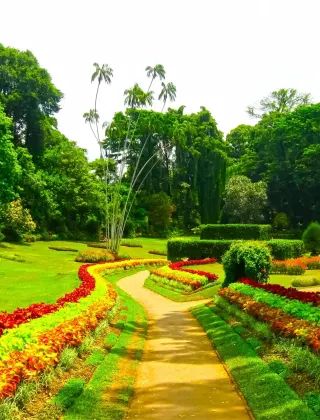
The most-photographed feature is the Giant Java Fig (Ficus benjamina) on the great lawn, estimated at 150 to 160 years old, with a canopy covering approximately 1,600 square metres. It looks like a large umbrella from a distance, with aerial roots hanging down to form what appears to be a cluster of separate trees. The three avenues of royal palms (Roystonea regia) are also worth walking; the formal layout contrasts with the wild-looking canopy cover of the older specimen trees. The orchid house contains a wide collection of Sri Lankan orchids, including Grammatophyllum speciosum (the world's largest orchid species) whose flower spikes can reach up to 3 metres. A spice garden near the entrance labels the plants that define Sri Lankan cooking: cinnamon, cloves, nutmeg, pepper, cardamom. The Mahaweli River runs along one side of the gardens and there is a suspension bridge across it. Allow 2 to 3 hours for a thorough visit; a golf cart service is available for those who prefer not to walk the full grounds.
Udawattakele Forest Reserve
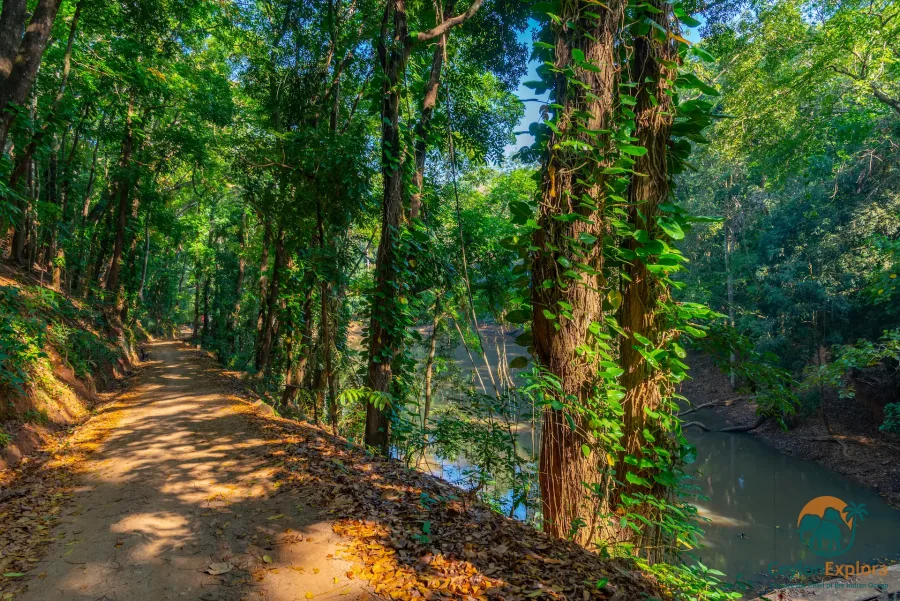
Immediately behind the Temple of the Tooth, a forested hill reserve of 104 hectares overlooks the city. Entry is approximately 3 USD for foreign visitors (verify current rate at the gate). Open 7:00am to 6:00pm; ticket sales close earlier. The trails are well-maintained colonial-era paths, the main one being Lady Horton's Drive, approximately 4.8 kilometres long, named when the British used this forest as a royal pleasure garden after 1815. Before that it was known as Uda Wasala Watta (garden above the royal palace), reserved exclusively for the Kandyan royal family and off-limits to commoners. The forest was designated a reserve in 1856 and reclassified as a sanctuary in 1938.
The canopy is home to toque macaques, purple-faced langurs, and around 80 bird species, including several Sri Lankan endemics such as the yellow-fronted barbet, brown-capped babbler, and the Sri Lanka hanging parrot. Slender loris and golden palm civet are present but rarely seen in daylight. It is not a dramatic wildlife experience, but for anyone with an hour and an interest in birds, it is a useful addition to a temple morning. The forest entrance is directly adjacent to the temple complex.
Gem Shopping in Kandy
Sri Lanka is one of the five most important gem-bearing nations in the world, alongside Myanmar, Brazil, South Africa, and Thailand. Kandy functions as the main gem trading and cutting city of the hill country. The nearest mining areas are the Elahera gem field in the Central Province (roughly 60–70 km north of Kandy, via Matale), which produces blue sapphires, cat's eye chrysoberyl, garnet, spinel, tourmaline, and zircon, and is one of the country's most productive gem fields. Ratnapura, further south-west, is the primary sapphire mining district.
The main gem and jewellery strip in Kandy runs along D.S. Senanayake Veediya in the city centre, with additional dealers along Peradeniya Road heading west. Loose stones and set jewellery are both available. To buy safely: only purchase from dealers who display a current licence from the National Gem and Jewellery Authority (NGJA) and who provide a certificate from NGJA, GIA, or AGL laboratory with the stone. The NGJA certifies gem authenticity, quality, and country of origin, and licenses dealers and exporters. Its official website is ngja.gov.lk.
Gem scams in Kandy are well-documented and follow consistent patterns. Tour guides and tuk-tuk drivers commonly collect commissions of 60% or more from shops they bring tourists to; any unsolicited recommendation is almost certainly a high-commission environment. Synthetic, heat-treated, and glass stones are sold as natural without disclosure at unlicensed stalls. The "investment export" pitch (the claim that you can resell at a profit in your home country) is a reliable indicator of fraud; the stones in these transactions are almost always low-grade or fake.
Genuine Ceylon blue sapphires sell from approximately USD 200 per carat for mid-grade stones to USD 1,000 or more per carat for eye-clean cornflower-blue material. A "bargain" sapphire offered at USD 30–100 in a street stall is not a bargain. Cat's eye chrysoberyl (one of Sri Lanka's most distinctive stones) can reach USD 2,000 per carat for fine honey-coloured stones with strong chatoyancy. If you are considering a serious purchase, prices at this level require independent laboratory certification, not just a shop certificate, to be verifiable. If you are buying souvenir-level jewellery in set silver or gold, established shops on the main gem strip are competitive and straightforward.
Batik and handloom fabric, spices, and woodcarvings are more straightforward purchases. The main souvenir shops on Dalada Veediya near the temple are competitive enough on price that significant bargaining is usually not necessary.
Local Markets
The Central Market at Market Street, a short walk from Kandy Lake, is open from early morning to around 9:00pm daily. The ground floor is a working produce market: fresh fruit, vegetables, and fish. Upper floors have fabric, traditional herbal medicines, and spices: cinnamon, cardamom, and cloves at wholesale prices well below souvenir shop rates. It is cash only. Best visited before 10:00am when produce is fresh and the space is less crowded. It is functional rather than arranged for tourists, which is part of what makes it worth a walk through.
The Kandy Esala Perahera Festival

The Esala Perahera is the largest annual festival in Sri Lanka, held in July or August according to the Sinhala lunar calendar, running for ten nights. In 2026, the projected dates are: Kumbal Perahera (nights 1–5): August 18–22; Randoli Perahera (nights 6–10): August 23–27; Day Perahera closing ceremony: August 28. The exact schedule is confirmed annually by the Diyawadana Nilame of the Temple of the Tooth; verify the official 2026 dates at sridaladamaligawa.lk closer to the festival.
The festival divides into two phases: the first five nights (Kumbal Perahera) build in scale, and the final five nights (Randoli Perahera) are the full procession with 100 or more elephants. Each night a 2 to 4-hour procession moves along the main streets near the temple, led by whip crackers and followed by Kandyan drummers and dancers, torch bearers, flag bearers, and elaborately dressed elephants. The temple's tusker elephant carries a golden casket containing a replica of the Sacred Tooth Relic; the actual relic does not leave the temple. The procession typically begins moving around 8:00pm and the full combined column can take 4 to 5 hours to pass a fixed viewing point.
If you want to attend the Perahera, book accommodation in Kandy at least three to six months in advance for Randoli nights, particularly the final two nights (August 26–27). Hotels with direct views of the procession route fill earliest and charge significant premiums. Viewing spots along the route fill several hours before the procession starts; if you do not have a reserved gallery seat, arrive early, bring water and food for a long wait, and keep bags close in the dense crowd. For 2026 package options including accommodation and gallery seating, contact Ceylon Explora directly.
Getting to Kandy
From Colombo by road: Approximately 3 hours by private car (115 km via the expressway), with the option to break the journey at a spice garden or viewpoint on the way. Allow extra time for traffic entering Kandy town
From Sigiriya: Approximately 2.5 to 3 hours by private car
From Nuwara Eliya: Approximately 2 to 2.5 hours by private car
From Ella: Approximately 3 hours by private car. Note: as of early 2026 the Kandy–Ella–Badulla hill country line is suspended due to Cyclone Ditwah track damage; check current service status at railway.gov.lk before planning train travel on this route
From Colombo by train, a budget alternative: The Colombo Fort to Kandy train climbs through river valleys and tea estates and arrives at Kandy station, 500 metres from the lake. The Intercity Express takes approximately 2.5 hours; other express services take 3 to 3.5 hours, and seats on the Intercity Express fill early at weekends
Kandy town is congested and parking is limited, but a private driver knows where to drop you close to the lake and can hold your luggage while you walk the last stretch, so this matters less than it looks. Tuk-tuks are available for short hops within the city; agree the fare before you get in.
Hill Country Connections
Kandy is the natural gateway to Sri Lanka's hill country. From here the main road climbs to Nuwara Eliya (75 km, approximately 2 hours) through tea plantation country, passing Ramboda Falls and several estate viewpoints. Kandy also marks the start of the scenic hill country train line, which runs through tea plantations, the Demodara Loop, and the Nine Arch Bridge at Ella across roughly 200 kilometres of highland terrain to Badulla. As of early 2026 this section is suspended due to Cyclone Ditwah track damage; check current service status at railway.gov.lk before planning rail travel through the hill country.
If you want a guide for the temple, a cultural show booking, a Perahera package, or a driver for the hill country circuit through Kandy, Nuwara Eliya, and Ella, the team at Ceylon Explora can arrange it. Contact us at hello@ceylonexplora.com or via WhatsApp at +94 71 777 7558.



From Fellow Travellers
Comments
No comments yet
Been here, or planning your own trip? Share your experience below and help the next traveller.
Leave a Comment
Comments are reviewed before publishing. No links, please. Email is optional and never shown.