

What Sigiriya Is
Sigiriya is a 200-metre granite monolith rising from the flat jungle of north-central Sri Lanka. In the 5th century AD, King Kashyapa turned it into a palace-citadel: the summit held his royal residence, the base held elaborate water gardens, and the sheer rock face was decorated with frescoes and polished to a mirror finish. He occupied it for 18 years. When he died in 495 AD, it became a Buddhist monastery and was later abandoned entirely. It was rediscovered by British archaeologists in the 19th century and designated a UNESCO World Heritage Site in 1982.
Today it is the most visited archaeological site in Sri Lanka and one of the most significant examples of 5th-century urban planning anywhere in the ancient world. The combination of artistic achievement (the frescoes), engineering achievement (the hydraulic gardens), and sheer physical scale makes it unlike anything else on the island.
Before You Climb: Practical Information
Entry fee: USD 35 for foreign adults, USD 20 for children aged 6-12 (CCF's own live price table, as of Sep 2026; verify at ccf.gov.lk/ticket-issuance before arriving, prices are exchange-rate-linked and update regularly).
Booking: Book online in advance at eservices.ccf.gov.lk/eticketing/landing (CCF's official eTicketing portal; orders are valid for booking up to 90 days ahead, but the physical ticket is valid only for the single day chosen).
Opening hours: 7am to 5:30pm daily, with the last entry at 5pm
Climb duration: 2 to 4 hours for the full ascent, exploration, and descent. Most people take about 3 hours
Difficulty: Moderate. The route involves approximately 1,200 steps across multiple stairways and platforms, with a few sections of steep iron staircase. It is suitable for reasonably fit adults and older children. People with a fear of heights may find the final exposed staircase challenging
What to bring: At least 1 litre of water per person (limited vendors on the rock), sunscreen, a hat. There is no shade after the base of the rock. Wear shoes with grip; the metal staircases can be slippery when wet or worn
Guides: Licenced guides are available at the entrance for approximately USD 10. If you want the historical context as you climb, a guide adds real value. The museum at the base also provides context before the climb
Best Time to Visit
Arrive at the ticket office by 7am. This is not a suggestion; it is the single most important practical decision about your Sigiriya visit.
By 9am, the sun is already strong and rising, and the rock face has no shade above the base. By 10am, large tour groups from Colombo and Negombo arrive, and the staircases become crowded, with queues at the lion-paw section and the frescoes gallery. By midday, the rock is unpleasant for most people.
At 7am, the temperature is manageable, the light on the rock face is soft and photogenic, and you will have the frescoes and the summit to yourself for the first hour. The descent in early morning is also significantly more comfortable than descending in full sun at noon.
Pidurangala sunrise alternative: If you want the iconic photograph of Sigiriya framed against a sunrise sky, you need to be at the top of Pidurangala Rock at dawn, not at Sigiriya itself. The two sites are 1 kilometre apart. See the section at the end of this guide for details.
The Climb: What You See at Each Level
The Water Gardens (Base Level)

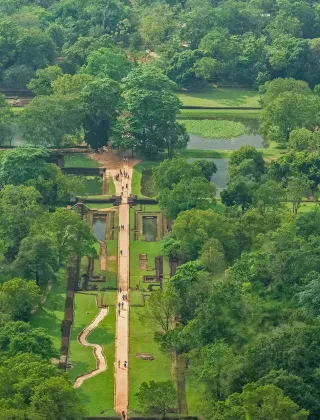
The gardens at the base of the rock are among the oldest surviving landscaped water gardens in the world. They were built in the late 5th century and functioned as an ornamental and functional hydraulic system: pools, fountains fed by underground pipelines, moats, and symmetrical garden beds. The fountains still work during the rainy season due to the original gravity-fed pressure system.
Take time at the base. Most visitors walk through quickly on the way to the rock; the gardens repay attention. The symmetry of the western water garden is particularly clear from the elevated pathway.
The Boulder Gardens and Cave Pathway

Above the water gardens, a boulder-strewn pathway leads through what was the outer palace zone. Several boulders have carved throne seats, cisterns, and drip ledges from the same period. Some caves along this section contain traces of ancient paintings and inscriptions. This section is often overlooked by visitors focused on reaching the summit stairs.
The Frescoes (Halfway Point)

The frescoes are reached about halfway up the rock via a spiral metal staircase that wraps around the sheer western face. The paintings depict Apsara figures (heavenly maidens) in natural pigments of yellow, red, brown, and green that have survived 1,500 years of exposure. 21 figures remain; historical accounts suggest there were originally around 500 covering a much larger area of the cliff face.
Photography of the frescoes is permitted but no flash. The lighting inside the alcove is limited; a phone camera handles it adequately in morning light. Tripods are not permitted. Allow 10 to 15 minutes; the ledge is narrow and queues build quickly after 8am. The contrast between the original estimated 500 figures and the 21 that survive makes this a visually and historically significant stop.
The Mirror Wall

Immediately beyond the frescoes is the Mirror Wall, a plastered surface polished to a reflective finish fine enough to mirror a person's image clearly. The wall is now covered in Sinhalese graffiti poetry left by visitors over a span of 1,000 years, some dating to the 8th century. These writings, preserved in old Sinhala script, are one of the most important collections of ancient literary commentary in the world.
Do not touch the Mirror Wall. This is enforced. The oils from hands accelerate deterioration of the remaining plaster surface.
The Lion's Paw Gate

Before the final ascent, two enormous carved stone lion paws sit on a wide terrace at the base of the summit rock. These are the only surviving parts of a full lion statue that once framed the entrance to the final staircase: the rock takes its name from this structure ("sinha" = lion, "giri" = rock). The statue's body has fallen, but the paws give an accurate sense of the original scale.
The final staircase from the lion paws to the summit is a near-vertical iron structure built into a groove in the rock face. It is the most physically demanding and, for some visitors, the most nerve-wracking section. Take your time. The handrails are solid.
The Summit

The summit covers approximately 1.6 hectares. The remains of the royal palace, throne rooms, cisterns, and gardens are laid out across the flat top. On a clear day, the Knuckles mountain range is visible to the east and the Dambulla ridge to the west.
Allow 20 to 30 minutes at the top before descending. The descent is faster than the ascent but requires careful footing on the metal staircases, especially if they are wet from morning dew or recent rain.
After Sigiriya: Pidurangala Rock

Pidurangala Rock lies 1 kilometre north of Sigiriya. It has its own cave temple (the Pidurangala Royal Cave Temple, 5th century, with a large reclining rock Buddha) and a shorter, rougher trail to the summit (45 minutes to the top).
The summit view of Sigiriya from Pidurangala is the one that appears in most photographs and travel features: the Lion Rock rising from the jungle canopy, perfectly framed by the surrounding plain. This view cannot be obtained from inside Sigiriya itself.
Entry to Pidurangala is collected at the temple gate, reported between LKR 500 and LKR 1,000 (roughly $2-3), cash; confirm on arrival. The trail involves some scrambling over loose boulders near the summit. The best time is sunrise: arrive at the Pidurangala base by 4:45am to reach the summit before 5:30am, when first light hits Sigiriya. Bring a torch for the lower trail in darkness.
Nearby: Dambulla Cave Temple

Dambulla is 20 kilometres south of Sigiriya, a 30-minute drive. The five cave temples contain 157 Buddha statues and 2,100 square metres of cave paintings. If you are visiting Sigiriya in the morning, Dambulla makes a logical afternoon stop before continuing to Kandy or Polonnaruwa. Entry is approximately USD 15.
Where to Stay Near Sigiriya
The town of Sigiriya and the nearby town of Habarana (10 kilometres south) have a range of accommodation, from simple guesthouses at $20 to $40 per night to mid-range jungle lodges at $80 to $150. Staying inside Habarana puts you within range of both Sigiriya and Minneriya National Park (elephant safaris), making it a practical base for two nights.
If your budget allows, the lodges immediately adjacent to the Sigiriya site offer the most direct access and some have pools with views of the rock face.
Getting to Sigiriya
From Colombo: 4 hours by private car or approximately 5 hours by bus (change at Dambulla)
From Kandy: 2.5 hours by private car
From Polonnaruwa: 45 minutes to 1 hour by private car
Tuk-tuks: Available from Sigiriya village to the site entrance for approximately LKR 300 to 500 each way; from Habarana or Dambulla town, expect LKR 600 to 1,200
Plan Your Cultural Triangle Visit
Sigiriya, Dambulla, Polonnaruwa, and Anuradhapura form the core of Sri Lanka's Cultural Triangle. All four can be covered in three to four days as part of a wider island tour. The team at CeylonExplora arranges Cultural Triangle tours with private drivers and local guides who know the sites in detail. Get in touch if you want the route planned before your trip.


From Fellow Travellers
Comments
No comments yet
Been here, or planning your own trip? Share your experience below and help the next traveller.
Leave a Comment
Comments are reviewed before publishing. No links, please. Email is optional and never shown.