

Why Sri Lanka's History Matters for Travellers
Sri Lanka has a recorded history stretching back more than 2,500 years. The ruins you walk through at Anuradhapura were already old when the Roman Empire was at its peak. The fort walls at Galle were built by the Dutch in the 17th century over a Portuguese foundation that itself sat on an older Sinhalese trading port. Knowing the layers helps. When you see a dagoba (stupa) rising above the treeline, or a Dutch door frame set into a British-era building, you understand what you are looking at and why it is there.
The outline most visitors carry — "Anuradhapura, then Polonnaruwa, then Kandy" — skips three centuries of history and several kingdoms that shaped the island as deeply as the more famous ones. This article covers the full arc: the ancient capitals, the medieval period, the wandering kingdoms that bridged the gap, the parallel Jaffna kingdom of the north, and the three colonial powers that divided the island before independence in 1948.
The Ancient Capital: Anuradhapura (377 BC to 993 AD)
The Kingdom of Anuradhapura, established in 377 BC, is where Sri Lanka's recorded urban history begins. For over 1,300 years it served as the political and religious capital of the island. It sat in the heart of Rajarata — the "King's Country," the dry-zone plains of the north-central province that formed the heartland of ancient Sinhalese civilisation, watered by an extensive network of reservoirs and canals.
The two most impressive structures are:
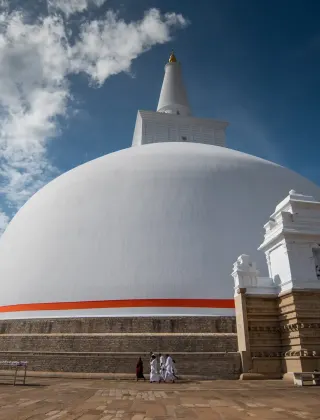
Jetavanaramaya stupa: Built in the 3rd century AD under King Mahasena, it originally stood approximately 122 metres high, making it one of the tallest structures in the ancient world at the time of its construction. It required approximately 93 million fired bricks, said to contain more fired-brick volume than any other ancient structure outside Egypt
Ruwanwelisaya stupa: Built in the 2nd century BC by King Dutugamunu, standing 103 metres, enclosing a relic chamber and surrounded by a carved elephant wall. It is listed among the sixteen sacred sites (solosmasthana) in Sri Lankan Theravada Buddhist tradition and remains an active pilgrimage site year-round
The city's greatest religious treasure arrived in the 3rd century BC: the Sri Maha Bodhi tree, grown from a cutting of the original Bodhi tree in Bodh Gaya, India, under which the Buddha attained enlightenment. It was brought to Sri Lanka by the nun Sanghamitta, daughter of Emperor Ashoka of India. The tree has been tended continuously for over 2,270 years, making it the oldest documented living tree with a verified planting date anywhere in the world.
In 993 AD, King Rajaraja I of the South Indian Chola dynasty invaded and seized northern Sri Lanka, sacking Anuradhapura and establishing a new provincial capital at Polonnaruwa to the southeast. His son Rajendra I completed the conquest by 1017, capturing the last Sinhalese king and briefly bringing the entire island under Chola imperial rule — the only time in recorded history a South Indian dynasty held all of Sri Lanka.
The Medieval Capital: Polonnaruwa (1070 to 1215 AD)
The Chola occupation lasted 77 years. In 1070, King Vijayabahu I, who had fought a 17-year campaign from the southern Ruhunu region, expelled the Chola forces and was crowned at Polonnaruwa. Rather than restore the devastated Anuradhapura, he made Polonnaruwa the new capital. It remained the seat of Sinhalese power for roughly 150 years.
King Parakramabahu I (reigned 1153 to 1186 AD) was Polonnaruwa's greatest builder. His most enduring achievement was the Parakrama Samudra, a man-made lake covering 2,440 hectares and storing 134 million cubic metres of water. It still irrigates farmland in the Polonnaruwa district today, 850 years after it was dug.
The Gal Vihara, carved during Parakramabahu's reign, is the highlight of any visit. Four monumental Buddha figures were cut directly from a single granite face: a 15-metre reclining Buddha entering parinirvana, a 7-metre standing Buddha, and two seated meditating figures. The precision of carving across an unbroken granite face at this scale makes it one of the most technically accomplished examples of medieval Sri Lankan stone sculpture.
In 1215, a South Indian warlord named Kalinga Magha landed at Karainagar with approximately 24,000 soldiers and seized Polonnaruwa. His occupation was marked by destruction of Buddhist infrastructure and forced displacement of the Sinhalese population southward. The Polonnaruwa era effectively ended with his arrival.
The Wandering Capitals (1215 to 1597)
Magha's invasion forced successive Sinhalese kings to abandon the open plains of Rajarata and retreat south and west into more defensible terrain. Over the next three and a half centuries, the capital moved six times, each relocation driven by invasion pressure, dynastic conflict, or the search for safer ground. This period is often glossed over in brief history summaries, but it shaped the island's cultural geography as much as any single kingdom.
Dambadeniya (c. 1220 to 1345)
Vijayabahu III established the first post-Polonnaruwa capital at Dambadeniya, roughly 110 kilometres southwest of Polonnaruwa, in the early 1220s. His son Parakramabahu II (reigned 1236 to 1270) recovered the Sacred Tooth Relic, which had been hidden in Kotmale during Magha's occupation, and by 1255 had expelled Magha from Polonnaruwa entirely. The Dambadeniya period is also notable as a high point of classical Sinhala literature: Parakramabahu II authored the poem Kausilumina, and the royal court actively patronised Sinhalese literary arts.
Yapahuwa (1273 to 1284)

Bhuvanekabahu I moved the court to Yapahuwa, a 90-metre granite rock outcrop in the North Western Province, deliberately modelled on Sigiriya as a fortified royal stronghold. The Tooth Relic was housed in a temple at the top of an ornate carved staircase, fragments of which still stand today. In 1284, a Pandyan raiding force from South India seized the relic and carried it back to India. It was recovered in 1288 by Parakramabahu III, and Yapahuwa was then largely abandoned, left to monks and jungle.
Kurunegala (1293 to 1341)
The capital moved again to Kurunegala, surrounded by a ring of large granite outcrops offering natural defensive cover. For nearly half a century it served as the seat of Sinhalese power. Virtually nothing of the palace complex survives above ground, but the town remains an important regional hub today — positioned roughly at the centre of the island, connecting the hill country to the northwest coast.
Gampola (1341 to c. 1408)
Bhuvanekabahu IV moved the court to Gampola, deeper in the central highlands near present-day Kandy, for greater protection from coastal pressure. The most significant monument of this period is the Lankatilaka Vihara, commissioned in 1344: a four-storey image house built on a rock outcrop, blending Sinhalese and Dravidian architectural traditions. Its remains, including a large seated Buddha, stand outside Kandy and are worth a visit. The Ambekke Dewalaya shrine, known for its carved wooden pillars, also dates from the Gampola period.
Kotte and Sitawaka (1412 to 1597)
The court eventually settled at Kotte (Sri Jayawardenepura Kotte), a fortress site surrounded by marshland on the western coastal plain near present-day Colombo. Parakramabahu VI (reigned 1412 to 1467) is the last native Sinhalese sovereign to unify all of Sri Lanka under a single banner: in 1450 his armies conquered the Jaffna Kingdom in the north, bringing the entire island under one ruler for the first time in centuries.
The Portuguese arrived in 1505, when Lourenço de Almeida's fleet sheltered off Colombo during a storm. What began as a trade relationship quickly became a contest for dominance. When the Kotte king Vijayabahu VII died in 1521, his three sons split the kingdom. The eldest held Kotte and accommodated the Portuguese; the youngest, Mayadunne, received Sitawaka and spent his entire reign fighting them. Mayadunne's forces destroyed a Portuguese army at the Battle of Mulleriyawa in 1562. His son Rajasinha I laid siege to Colombo in 1587 to 1588 with a recorded force of 50,000 men, 2,200 elephants, and 150 bronze cannon. The Portuguese garrison held. Rajasinha I's sudden death in 1593 ended Sitawaka's resistance and surrendered the coastal lowlands to Portugal.
In 1597, the last Kotte king Dharmapala, a Catholic convert with no heirs, bequeathed his kingdom to the Portuguese Crown by deed of gift. The Sinhalese lowland kingdoms were over. Sri Jayawardenepura Kotte is today the official legislative capital of modern Sri Lanka — a geographic continuity spanning six centuries.
The Jaffna Kingdom (c. 1215 to 1619)
While the Sinhalese courts moved south and west, a separate kingdom took hold in the north. The Jaffna Kingdom emerged from the power vacuum created by Kalinga Magha's 1215 invasion, with the Aryacakravarti Tamil dynasty establishing firm control over the Jaffna Peninsula and the Vanni region. At its peak it controlled the northern and northwestern coasts and competed with the Sinhalese kingdoms for influence over central Sri Lanka.
Parakramabahu VI of Kotte conquered the Jaffna Kingdom in 1450, temporarily bringing the north under Sinhalese suzerainty, but it re-established independence after his death. The Portuguese began attacking Jaffna from 1560 onwards. After installing a puppet ruler in 1591, they completed the conquest in June 1619 under Phillippe de Oliveira. The last king, Cankili II, along with the surviving royal family, was taken to Goa and executed.
Jaffna Fort, which the Portuguese built in 1618 during the campaign that ended the kingdom, was subsequently enlarged by the Dutch VOC into a pentagon-shaped star fortress after 1658. It is considered one of the most complete examples of Dutch military architecture in Asia. The fort still stands in Jaffna town, garrisoned by the Sri Lanka Army but open to visitors.
The Last Kingdom: Kandy (c. 1469 to 1815)
While the coastal kingdoms fell one by one to European powers, the Kingdom of Kandy in the central highlands kept its independence for over 300 years. Positioned in Uda Rata — the "Up-Country," the interior highland zone — Kandy was shielded by mountain terrain that neutralised the Portuguese and Dutch advantage in artillery and open-field warfare. The kingdom's rulers allied with the Dutch against the Portuguese in 1638, then resisted Dutch territorial expansion, then manoeuvred between the Dutch and British as European power shifted.
From 1739 onwards, the Kandyan throne passed to the Nayakkar dynasty, a royal house of South Indian Tamil origin from Madurai, connected to the existing Kandyan royal family through marriage. The last Kandyan king, Sri Vikrama Rajasinha, was a Nayakkar. His increasingly arbitrary rule alienated the Kandyan aristocracy: in 1815, senior chiefs invited the British to intervene, and the king was handed over without significant military resistance. The Kandyan Convention was signed on 2 March 1815 at the Audience Hall in Kandy, transferring sovereignty to the British Crown. Sri Vikrama Rajasinha was exiled to Vellore Fort in India, where he died 17 years later.
Kandy's most significant legacy is the Temple of the Tooth Relic (Sri Dalada Maligawa), which holds what is believed to be a tooth of the Buddha, brought to Sri Lanka in 313 AD. Possession of this relic was historically tied to the right to govern; any ruler who held it held political legitimacy. The British took custody of it briefly after 1815 before returning it to the temple under local administration. The temple is the most sacred Buddhist site in Sri Lanka and draws pilgrims from across the world every day of the year.
Three Colonial Centuries (1505 to 1948)
The Portuguese (1505 to 1658)
The Portuguese established a fort at Colombo in 1517, turning what had been a Moor trading settlement into their main coastal garrison and administrative centre. From Colombo they extended control over the Pahatha Rata — the low-country coastal belt of the west and south — using the cinnamon trade as their economic engine. They introduced Christianity and Catholic church architecture to the coastal regions, traces of which remain in church buildings and family names across western Sri Lanka. In the north, they met sustained Sinhalese resistance from Sitawaka before finally consolidating control after Rajasinha I's death in 1593.
The Dutch (1658 to 1796)
The Dutch East India Company (VOC) allied with the Kingdom of Kandy in 1638 to expel the Portuguese. After capturing Colombo in 1656 and the last Portuguese stronghold at Jaffnapatnam in 1658, the Dutch retained the coastal territories for themselves rather than returning them to Kandy as promised. Dutch colonial architecture, canal systems, Roman-Dutch law, and the distinctive fortifications of Galle all date from this period. The VOC's primary commercial interest was cinnamon, which Sri Lanka produced in greater quality than anywhere else in the world at the time. After the Kandyan-Dutch War of 1764 to 1766, the Dutch forced the Kandyan king to sign the Treaty of Batticaloa, which made Kandy effectively landlocked by granting the Dutch sovereignty over all coastal areas extending one Sinhala mile inland.
The British (1796 to 1948)
Britain occupied the Dutch coastal territories in 1796, motivated by concerns that French expansion would give France access to the island. The Treaty of Amiens in 1802 formally transferred Dutch Ceylon to Britain. In 1815 the British annexed Kandy, making Sri Lanka a single unified British Crown Colony for the first time in its history. The 1817 to 1818 Uva Rebellion — a broad Kandyan uprising against British rule — was suppressed, after which most of the protections the 1815 Convention had promised the Kandyan chiefs were stripped away.
The British transformed the island's economy: they cleared highland rainforest for coffee plantations from the 1840s, then switched to tea after a coffee blight devastated crops in the 1870s. Sri Lanka is today the world's third-largest tea exporter by volume. To staff the plantations, the British brought hundreds of thousands of Tamil workers from South India, creating a distinct population group, the "Indian Tamils," separate from the longer-established "Ceylon Tamils" of the north.
Sri Lanka gained independence on 4 February 1948, and the date is observed as Independence Day. The country officially changed its name from Ceylon to Sri Lanka in 1972 when it became a republic.
Sri Lanka's Eight UNESCO World Heritage Sites
Sri Lanka has eight UNESCO World Heritage Sites: six cultural and two natural. All six cultural sites can be visited on a standard tour of the island.
Cultural Sites
Ancient City of Anuradhapura (1982): The island's first capital, with 2,000 years of Buddhist monuments, the Sri Maha Bodhi tree, and the great stupas. Allow two half-days to cover the main archaeological zone by bicycle
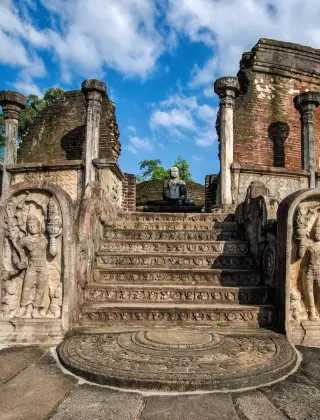
Ancient City of Polonnaruwa (1982): The medieval capital with the Gal Vihara rock carvings, the royal palace complex, and the Parakrama Samudra reservoir. One full day by bicycle covers the main circuit
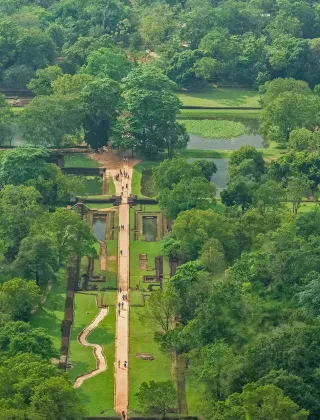
Sigiriya Rock Fortress (1982): The 5th-century rock citadel of King Kashyapa, with its water gardens, mirror wall, and Apsara frescoes. Entry is USD 35, as of Sep 2026 (verify at ccf.gov.lk/ticket-issuance); arrive by 7am to avoid crowds and midday heat
Sacred City of Kandy (1988): The last royal capital and home of the Temple of the Tooth Relic. The city is compact and walkable; the lake walk and the temple can be covered in half a day
Golden Temple of Dambulla (1991): Five cave temples with 157 Buddhist statues and 2,100 square metres of cave paintings, the oldest dating to the 1st century BC. The cave-temple entrance fee is collected separately from CCF's national ticket system (CCF only prices a small on-site museum here, $3); the temple entrance is commonly cited around $5-10, unconfirmed by any primary source, confirm locally
Old Town of Galle and its Fortifications (1988): A Dutch colonial fort town with cobblestone streets, a working lighthouse, and 400 years of layered European architecture. The walled city is walkable in 45 minutes; the fort deserves at least half a day if you stop to eat and browse
Natural Sites
Sinharaja Forest Reserve (1988): Sri Lanka retains less than 1.5% primary lowland rainforest cover; Sinharaja, at 89 square kilometres in the southwest, is the largest contiguous intact block remaining. Home to 26 endemic bird species and over 50% of endemic tree species on the island. Visit between January and April for drier conditions
Central Highlands of Sri Lanka (2010): Includes Horton Plains National Park (with the World's End escarpment, which drops approximately 880 metres to the lowland plains below), Peak Wilderness Protected Area (Adam's Peak), and the Knuckles Conservation Forest
Planning a Heritage Route
The six cultural UNESCO sites can be linked as a single circuit: Anuradhapura and Polonnaruwa in the north (the Cultural Triangle, together with Sigiriya and Dambulla), then Sigiriya, Dambulla, Kandy, and Galle on the south coast. This covers roughly 500 kilometres and suits 7 to 10 days of travel.
Visitors interested in the wandering capitals can add a day to the standard Cultural Triangle circuit: Yapahuwa is 35 kilometres from Kurunegala, and Dambadeniya is a further 20 kilometres south — both accessible as a half-day detour between Anuradhapura and Kandy. Jaffna, with its fort and the northernmost tip of the island, makes a compelling addition for travellers with an extra two to three days; it is 5 to 6 hours by road from Anuradhapura or 7 to 8 hours by train from Colombo.
Sigiriya, Polonnaruwa, and Anuradhapura are each priced and ticketed separately by CCF; as of Sep 2026, CCF's live price table shows no combined multi-site ticket. Dambulla Cave Temple is not part of CCF's ticketing system at all. Budget each site's entrance fee individually. (ccf.gov.lk/ticket-issuance)
If you want a guided heritage tour that connects the historical context to the physical sites you are walking through, the team at CeylonExplora designs itineraries around the full cultural circuit, including the lesser-visited medieval capitals. Get in touch to plan your route.


From Fellow Travellers
Comments
No comments yet
Been here, or planning your own trip? Share your experience below and help the next traveller.
Leave a Comment
Comments are reviewed before publishing. No links, please. Email is optional and never shown.