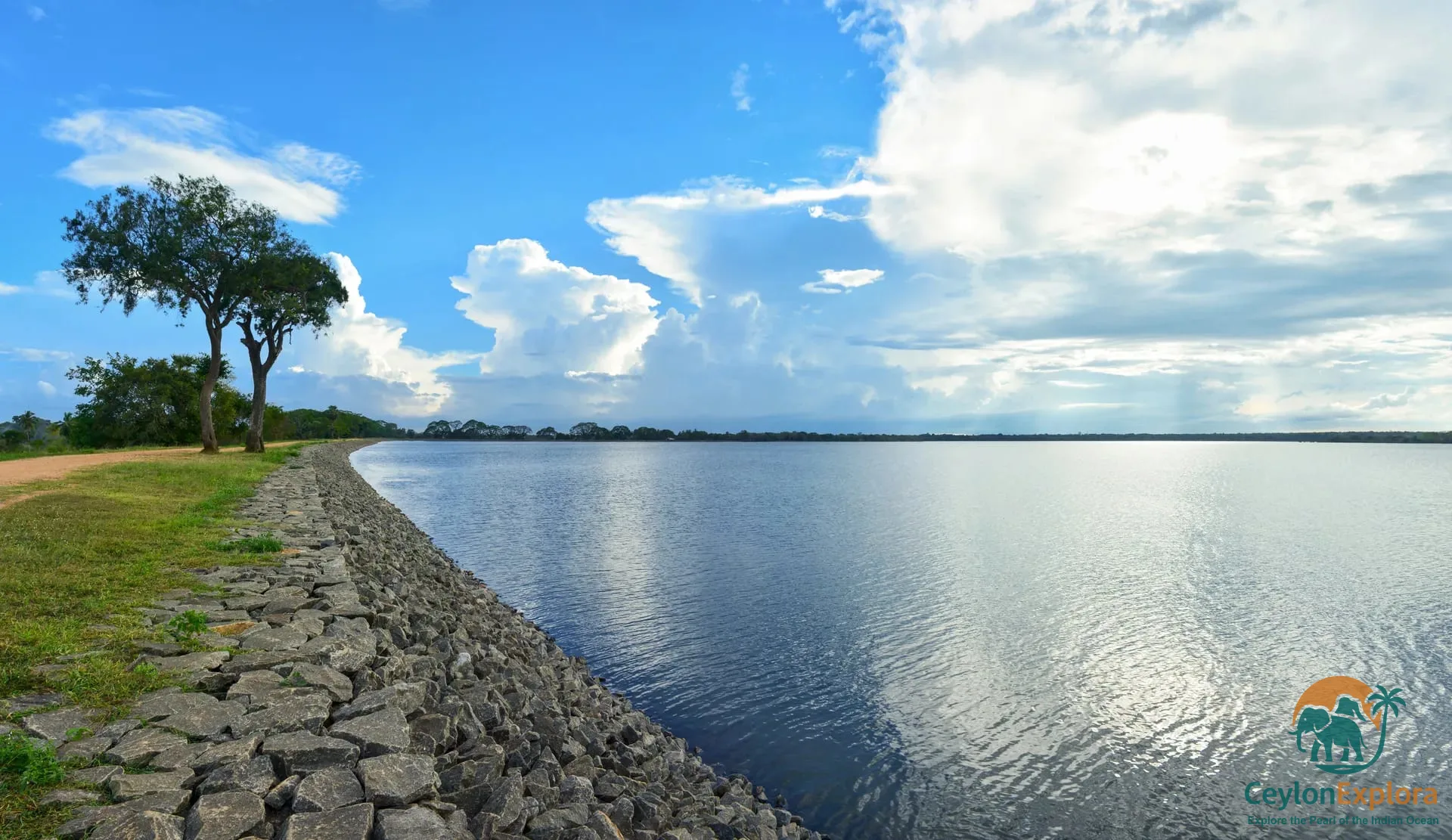
Tissa Wewa
Ancient reservoir built by King Devanampiyatissa in the 3rd century BC, now a wildlife haven where elephants come to drink at dusk.
Duration
1-1.5 hours
Entry Fee
Free
Difficulty
easy
Budget
free
About Tissa Wewa
Tissa Wewa is one of the oldest man-made reservoirs in Anuradhapura, attributed to King Devanampiyatissa in the 3rd century BC as part of the city's irrigation system. The tank spans approximately 160 hectares and sits at the southern edge of the sacred city, with the ruins of Isurumuniya Rock Temple rising from a boulder at its southern shore. Wild elephants from the surrounding forests regularly come to the reservoir's edge at dusk to drink and bathe, making the shoreline a popular spot for informal wildlife watching without a safari fee. The tank also supports painted storks, grey herons, and a variety of resident waterbirds. A gentle walk along the western bund at sunset, with views of the water and the Anuradhapura skyline including the stupa domes, takes about 45 minutes.
Highlights
- 3rd century BC reservoir, among Sri Lanka's oldest
- Built by King Devanampiyatissa as part of Anuradhapura's irrigation network
- Wild elephants visit the shore at dusk
- Painted storks, grey herons, and other waterbirds year-round
- Sunset walk with views of Anuradhapura's stupa skyline
Practical Tips
Walk the western bund at 5:30pm for the best chance of seeing wild elephants come to drink.
No entry fee for the reservoir bund itself; Isurumuniya temple on the southern shore requires the Anuradhapura combined ticket.
Bring insect repellent for evening walks near the water.
The reservoir is a short tuk-tuk or bicycle ride from the main Anuradhapura sacred precinct.
Explore by Interest
Best Time to Visit
Best time of day: Dusk (5pm–6:30pm) year-round for elephant sightings; dry season (January to April) for calm water.
Location
Planning Info
- Crowd level
- Usually quiet
- Physical difficulty
- easy
- Setting
- outdoor
- Child friendly
- Yes
- Senior friendly
- Yes
- Budget level
- free
- Photography
- ★★★☆☆
Plan Your Visit
Want to include Tissa Wewa in your Sri Lanka itinerary? Our team builds personalised plans: no booking fees, no online payment.
ALSO IN THE AREA
Nearby Destinations
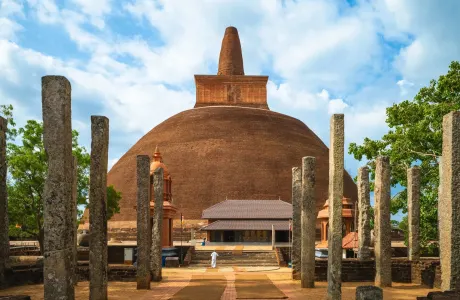
Abhayagiri Dagoba
1st-century BC stupa in Anuradhapura that once rose to 115m, making it the second tallest stupa ever built in the ancient world.
Explore →
Ruwanwelisaya Stupa
2nd-century BC stupa built by King Dutugemunu, standing 103m tall and enshrining relics of the Buddha in Anuradhapura.
Explore →
Isurumuniya Rock Temple
3rd-century BC rock temple in Anuradhapura with a famous carved panel of 'The Lovers', a royal bathing pool, and elephants carved in rock.
Explore →LET'S EXPLOR™ THE
Tour Packages
 from $0
Arugam Bay Surf and East Coast Escape
Arugam Bay sits on the opposite monsoon to everywhere else in this catalogue. While Colombo, Galle and the south coast are in their wet season, the east coast is dry and breaking cleanly, roughly May to October, with the most consistent swell and offshore wind from June to August. The town has several named breaks within a short ride of each other. Main Point is a powerful right-hand reef break in town that delivers 200 to 500 metre rides for intermediate and advanced surfers. Whiskey Point, 10 to 15 minutes north, is a gentler right-hander. Peanut Farm is a similarly mellow point break over sand and flat rock that works for beginners and advanced surfers alike. Lessons and board rental are booked and paid locally at the beach schools rather than pre-arranged, because that is how the town actually operates, and it means you pick your instructor and change plans day to day. The honest problem with a short Arugam Bay trip is the drive. It is about 8 hours 40 minutes from the airport in one push, and the same back, which on a 6-day trip meant two of six days spent entirely in a car. This version takes seven days and breaks the journey properly instead: a night at Habarana in the Cultural Triangle, a night on the quiet beach at Pasikudah, three nights at Arugam Bay, and a night at Tissamaharama for a Yala safari on the way home. No leg exceeds four hours, you see a coastline most visitors never reach, and you arrive able to surf rather than wrecked.
7 days / 6 nights
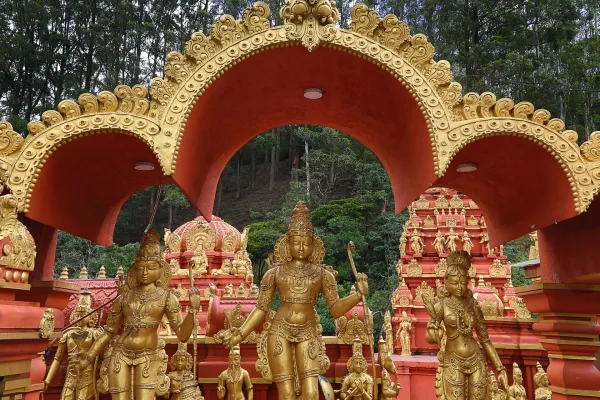 from $0
Ramayana Trail
Sri Lanka's Ramayana Trail links the places where, according to tradition, Rama, Sita, Hanuman and Ravana crossed paths after Sita's abduction: from the Shiva lingam Rama is said to have installed at Manavari, to the cave above Ravana Falls where legend holds Sita was kept, to the hill above Unawatuna that tradition calls a fragment of the herb-mountain Hanuman carried from the Himalayas. This 7-day circuit runs the length of the island in one direction. It starts on the west coast at Chilaw, climbs through Kandy into the tea hills at Nuwara Eliya, drops through Ella to the dry southern plains at Kataragama, and finishes on the south coast at Unawatuna. Each site gets its own part of the day rather than being stacked three to an afternoon, and no road is driven twice. Every site's Ramayana association is presented here as devotional tradition, not verified history, and your guide will frame it the same way. Vegetarian meals are confirmed at every hotel on request, and pure-vegetarian or Jain requirements are worth telling us at the time of booking rather than on arrival, because not every kitchen stocks for them by default.
7 days / 6 nights
 from $1125
Ceylon Grand Circle
The Grand Circle is one continuous clockwise loop. You land on the west coast, drive north into the dry-zone plains where Sri Lanka's first capitals were built, climb south and east through the tea highlands to 1,868 m, then come back down to sea level on the southern coast and run home along the expressway. No road is driven twice, and no stop is a detour you have to undo the next morning. The shape of the route is also the shape of the island's history. Anuradhapura was the capital for over a thousand years from the 4th century BC. Polonnaruwa replaced it in the 11th. Sigiriya's rock palace sits between them at the 5th. Kandy held the last independent kingdom until 1815 and still keeps the Sacred Tooth Relic. Above Kandy the road climbs into tea country the British planted from the 1860s, then drops through Ella into the dry southern plains where Yala's leopards are, and finally to the water at Mirissa and Galle. Fourteen nights across nine bases works out at roughly 900 km of driving. It is spread so the longest single transfer is three and a half hours, on day two, and most days are under two and a half. Five of the nine bases get two nights, so you unpack properly rather than living out of a bag. Your driver-guide covers the whole route; the only vehicle you change into is the safari jeep inside Yala, arranged locally on the morning.
15 days / 14 nights
PLAN YOUR VISIT
Ready to explore Tissa Wewa?
Tell us your travel dates, group size, and preferences. Our team will build a personalised itinerary with accommodation, transport, and entry tickets: no booking fees, no online payment required.