
What Ella Is
Ella is a small hill town in Sri Lanka's Uva Province, sitting at 1,041 metres above sea level in a natural gap in the mountain ridge that opens south toward the coastal lowlands. The town itself is essentially one main road with guesthouses, cafes, tour operators, and restaurants stacked along it. What surrounds it is the draw: the Nine Arch Bridge, two hikeable peaks with panoramic views, a waterfall with a mythological backstory, and the most famous section of Sri Lanka's hill country railway line.
Ella has become Sri Lanka's most popular backpacker destination over the past decade. It is busier than it once was, prices have risen, and the main strip can feel crowded at midday in peak season. That said, the hikes and the landscape are unchanged, and arriving early morning at the Nine Arch Bridge or at the summit of Little Adam's Peak gives you the experience largely to yourself.
Practical Information
- Best time to visit: January through March for the driest and clearest skies. June through August is a secondary dry period with fewer crowds. October and November are the wettest months and not ideal for hiking. For all hikes, start by 6 to 7am regardless of season — afternoon mist and cloud build quickly at this elevation
- Train service status: As of early 2026, all Main Line services through Ella (including the Ella Odyssey) are suspended following damage from Cyclone Ditwah. Verify the current status at railway.gov.lk or through your accommodation before planning around train travel to or from Ella
- Getting around: Tuk-tuks cover all the main sites from the town centre. Walking to the Nine Arch Bridge (2.5 km, 30 to 45 minutes) and Little Adam's Peak (2 km) is practical. Ella Rock requires a longer approach along the railway tracks
- Time needed: Two full days covers the Nine Arch Bridge, Little Adam's Peak, Ella Rock, and Ravana Falls comfortably
Nine Arch Bridge
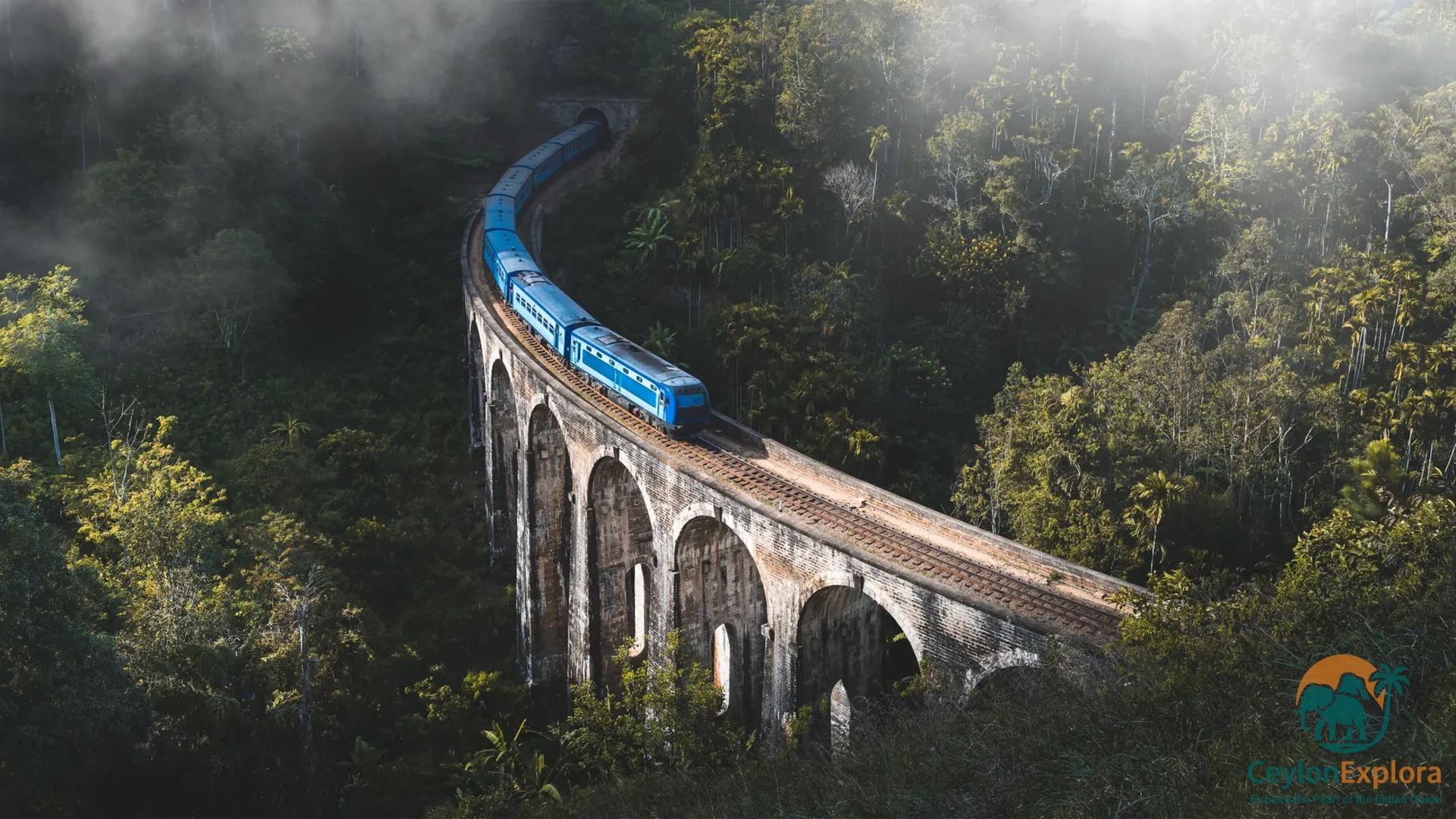
The Nine Arch Bridge at Demodara, between Ella and Demodara stations on the Main Line railway, was completed around 1919. It is 91 metres long and 24 metres high, built from stone, brick, and cement with no structural steel. The local account holds that the original steel allocation was redirected to British war projects during World War I, forcing the builders to use masonry construction throughout. The result is a bridge that has stood for over a century without the structural steel most railways of that era required. It is now designated an Archaeological Protected Monument.
The bridge itself carries rail traffic in both directions. There is no road across it. Visitors walk to it through the surrounding tea estate and view it from paths above and below the bridge level.
Getting to the Bridge
The bridge is about 2.5 kilometres from Ella town centre. Walking takes 30 to 45 minutes along the main road. Tuk-tuks charge roughly LKR 200 to 400 to the parking area, from which the bridge is a 5 to 10 minute walk. Most visitors walk both ways.
Photography
Two main viewpoints:
- Upper northern viewpoint: Approach from the Ella side of the bridge and take the path uphill to the right. Two small cafes (Cafe Soul and Asanka Cafe) sit directly above with sight lines down the full length of the bridge. This is the standard angle for the classic photograph of a train emerging from the tunnel arch
- Lower southern viewpoint (tea fields): Cross to the south side of the bridge and descend through the tea fields below the track level. This gives an upward-looking view showing all nine arches. Less visited and often less crowded
Early morning (6:30 to 7:30am) gives the best light, frequent mist in the valley below the bridge, and the fewest people. A train passes at approximately 9:15am on most days, which also has useful morning light. Verify current train times at Ella station the day before, as schedules shift and trains run up to an hour late.
Standing on the bridge when a train is coming is dangerous. Wait at the viewpoints, not on the track.
Little Adam's Peak

Little Adam's Peak stands at 1,141 metres, about 100 metres above Ella town. It is the most accessible hike in the area and the standard morning activity for visitors with limited time. The trailhead is approximately 2 kilometres from the town centre, reached by tuk-tuk (10 minutes) or a 20 to 25-minute walk along the road past 98 Acres Resort.
From the trailhead it is 15 to 20 minutes to the summit. The full round trip including the approach walk takes about 2 to 2.5 hours. The trail is well-maintained and suitable for most fitness levels. The summit ridge has three distinct high points; the third is the highest. From the top you can see across tea plantations, the Ella Rock face to the north, the Ella Gap opening to the southern plains, and Ravana Falls below on a clear day.
For the clearest views, arrive at the summit by 6:30 to 7am. Afternoon cloud builds from about 1pm and frequently obscures the view entirely. Bring a phone torch if starting pre-dawn.
Ella Rock
Ella Rock at 1,376 metres is the more demanding hike and the more rewarding one. The route starts at Ella railway station and follows the active railway tracks for roughly 40 minutes to Kithalella station, a small building on the line. Cross the footbridge at Kithalella, take the left fork, and the trail climbs through tea plantations to the summit. The round trip is approximately 10 kilometres from Ella town.
Allow a full half-day: 3 to 4 hours of walking plus time at the top. The trail is not technically difficult but the final section to the summit is a steeper climb. Entry at the viewpoint costs LKR 930 for adults. The summit gives a broader panoramic view than Little Adam's Peak, with the Ella Gap and the southern lowland plains spread out directly below. On clear mornings you can see far enough south to make out the coastal haze.
Walking on active railway tracks requires awareness: trains approach quietly and the tracks curve in places that limit visibility. Stay to the side of the track and be prepared to step fully clear quickly. A guide (roughly LKR 1,500 to 2,500) is not required but is occasionally useful if you want company on the longer sections.
Ravana Falls

Ravana Falls drops 25 metres into a natural pool on the A23 road, approximately 6 kilometres south of Ella toward Wellawaya. A tuk-tuk takes 10 to 15 minutes (roughly LKR 300 to 500 each way). There is no entry fee.
The falls are associated with the Ramayana, the Hindu epic: according to the tradition, the demon king Ravana concealed the kidnapped Sita in a cave above these falls, and she bathed in the pool at the base. The falls, the cave above them, and a nearby temple form part of a Ramayana pilgrimage circuit that draws significant numbers of Indian tourists. The mythological connection is tradition rather than historical record, but it gives the site a cultural context beyond the waterfall itself.
Swimming in the pool at the base is possible in the dry season. The rocks are slippery in all conditions. Avoid the pool during and after heavy rain when the flow is heavy and unpredictable.
Ravana's Cave

Above Ravana Falls, approximately 650 steps up the cliff face, is a natural cave associated with the same Ramayana tradition. Entry is approximately LKR 200 to 250 (confirm at the site). The cave has no carvings or archaeological features — it is an unadorned natural formation. The climb is strenuous and the cave itself is the least remarkable part; the views from the cliff face on the way up are the actual reward. Worth considering only if you have a specific interest in the Ramayana circuit.
The Demodara Loop

Just past Ella station on the line toward Badulla, the track descends in a spiral loop to gain elevation in a very short horizontal distance. The train spirals downward for approximately 900 metres, passes through a 320-metre tunnel (Tunnel No. 42), and emerges at a lower level. Demodara station sits directly above this tunnel, making it the only railway station in the world positioned above a tunnel within a spiral loop. The loop was completed in the early 1920s, shortly after the Nine Arch Bridge.
From the train, the Demodara Loop is experienced as the track appearing to double back on itself. Looking back from the train shortly after Ella you can sometimes see a section of the line above you that you were on minutes before. The Demodara station itself is a small halt where you can disembark, look down at the tunnel mouth directly below the platform, and take the next train back to Ella.
Note: verify current train service status before planning any train-based activity at Ella. As of early 2026, the Main Line services through this section are suspended.
The Hill Country Train Journey
When services are running, the train journey through this section of the hill country is one of the most frequently discussed rail experiences in Asia. The stretch from Nanu Oya (the station for Nuwara Eliya) through Haputale to Ella covers roughly 64 kilometres of mountain terrain in approximately 2.5 to 3 hours, passing through cloud forest, tea estates, and a series of tunnels and viaducts with drops into deep valleys on both sides of the track.
From Colombo Fort, Ella is about 8.5 to 10 hours by train (delays are common; plan for the full 10 hours). From Kandy it is approximately 7 to 8 hours on schedule, often longer in practice. Observation Saloon carriages (first class, panoramic windows) sell out well in advance and must be booked online at seatreservation.railway.gov.lk. For real-time train tracking and delay updates, the RDMNS app (rdmns.lk) is a widely used community tool. Second class reserved is a reliable alternative. Budget travellers take third class unreserved and stand in the open doorway between carriages, though this is technically not permitted and requires judgement on safe conditions.
Before booking any train travel, confirm the current service status at railway.gov.lk or through your accommodation. The suspension following Cyclone Ditwah was not resolved as of early 2026 and no definitive timeline had been published.
Zip-lining: Flying Ravana

The Flying Ravana Mega Zipline, operated by 98 Adventures, is Sri Lanka's first dual mega-zipline. Two parallel lines run 550 metres across the hillside, reaching approximately 80 kilometres per hour. It operates daily from 8:30am to 5pm. One ride costs approximately LKR 6,500 per person (roughly USD 20 at current rates; confirm with the operator as prices change). The ride is popular with most visitors but the LKR 6,500 price point is notable compared to the cost of the hikes, which are largely free or very low cost.
Getting to Ella
- From Kandy by road: Approximately 3 to 3.5 hours by private car, with stops possible in the hill country along the way
- From Nuwara Eliya by road: Approximately 2 hours by private car (about 65 km)
- From the south coast (Mirissa, Galle): Approximately 5 to 6 hours by private car. Private car hire from Mirissa costs roughly LKR 12,000 to 18,000. No direct bus; a bus requires changing at Matara and takes 8 to 9 hours
- From Haputale: 24 kilometres, approximately 25 to 30 minutes by car or tuk-tuk
- By train, a budget alternative when services run: From Colombo Fort approximately 8.5 to 10 hours. From Kandy approximately 7 to 8 hours on schedule, often longer. From Nanu Oya (Nuwara Eliya) approximately 2.5 to 3 hours. Verify current service status at railway.gov.lk before planning around it
Combining with the Hill Country
Ella fits naturally at the end of a hill country circuit: Kandy, then Nuwara Eliya (Horton Plains), then Ella. From Ella the practical next destinations are the south coast (Mirissa or Galle, 5 to 6 hours by road) or heading back toward Colombo via the expressway from Wellawaya. Many visitors also continue to Arugam Bay on the east coast (approximately 3 hours from Ella).
If you want a driver for the full hill country circuit or private transport from Ella to the coast, the team at CeylonExplora can arrange it. Get in touch to plan the route.






From Fellow Travellers
Comments
No comments yet
Been here, or planning your own trip? Share your experience below and help the next traveller.
Leave a Comment
Comments are reviewed before publishing. No links, please. Email is optional and never shown.