

What Nuwara Eliya Is
Nuwara Eliya sits at 1,868 metres above sea level in Sri Lanka's central highlands, making it the coldest town on the island. Daytime temperatures rarely exceed 20°C and nights can drop to single figures. The surrounding hillsides are covered in tea, the town centre has the architecture of an English market town transported to the tropics, and the air has the kind of clarity that is absent from the coast. It is a genuinely different Sri Lanka from what most visitors expect.
The British developed the area from the 1840s as a highland retreat from the coastal heat. Governor Sir Edward Barnes built infrastructure from 1846, and the explorer Samuel Baker, who arrived in 1847, established a farming settlement and wrote extensively about the town's resemblance to the English countryside. The colonial character he and other planters cultivated — a racecourse, golf club, English-style gardens, and brick buildings — persists well enough to justify the "Little England" label.
Practical Information
- Altitude and temperature: 1,868 metres. Pack a fleece or light jacket even if you are travelling in the Sri Lankan "summer." Nights in January and February can drop close to 5°C
- Best time to visit: January through April for dry, clear weather. February and March are the Western Quality Season for Nuwara Eliya tea, when the finest single-origin teas are produced. The town is extremely busy in April during the Sinhala New Year period
- Time needed: Two days covers the town, one or two tea estate visits, Gregory Lake, and Victoria Park. Add a third day for a Horton Plains day trip
- Getting around town: The colonial centre, Gregory Lake, and Victoria Park are all within a short walk or tuk-tuk ride of each other. Tuk-tuks to tea estates and outlying attractions are straightforward to arrange
Colonial Architecture
The core of Nuwara Eliya town is a 10 to 15-minute walk across. The colonial buildings are concentrated around the main road and racecourse and are best explored on foot.
The Hill Club
Founded in 1876 by British coffee planters, the Hill Club was the social heart of the colonial planter class for over a century. Membership was restricted to European men until 1967, when Sri Lankan nationals were first admitted. Women were also barred from full membership during the colonial era. The current building dates from the 1930s and the interiors are deliberately unchanged: mounted deer heads, tartan upholstery, a snooker room, a library of pre-independence books, and a formal dining room with silver service. Non-members can visit as "temporary members" for meals, afternoon tea, or drinks with a reservation. Men must wear a jacket and tie after 7pm; the club keeps spare jackets by the entrance if you arrive unprepared. The high tea here, served in the main lounge with a direct view of the garden and distant hills, is one of the more distinctive afternoon experiences in Sri Lanka.
The Grand Hotel
The Grand Hotel was originally built in 1828 as the private residence of Governor Sir Edward Barnes, known as "Barnes Hall." It was sold in 1892, expanded with a second storey, and has operated as a hotel ever since. The hotel was declared a National Heritage Property by Sri Lanka's Archaeology Department in 1990 and gazetted as a protected monument in 2007. It also holds the Sri Lanka Tourism Development Authority's Heritage Grand classification, the first hotel in the country to receive it. Today it is a functioning four-star hotel. You can walk through the public areas, eat in the restaurant, or have a drink in the bar without staying. The entrance hall and dining room retain the original proportions of the 19th-century building.
The Post Office and Holy Trinity Church
The post office on Kandy Road, built in 1894 in Tudor style with red brick and a clock spire, is the most photographed colonial building in town aside from the hotels. It is still a working post office. Holy Trinity Church, started in 1845 and consecrated in 1852, is an Anglican church built by officers and soldiers of the British 15th Regiment. The interior has memorial plaques to colonial planters and officials, and a stained glass window gifted by Queen Elizabeth II during her 1954 tour. Both buildings are worth a brief stop on a town walk.
Tea Plantation Visits
Nuwara Eliya produces Sri Lanka's highest-altitude teas, grown at 1,600 to 1,900 metres. At this altitude the tea plant grows slowly, concentrating flavour compounds in the leaf. The result is a pale golden infusion with a light, delicate character, floral and citrus notes, and mild astringency. It is the lightest of all Ceylon tea regions. The Sri Lanka Tea Board's trade materials describe it as the "Champagne of Ceylon teas," a designation used consistently across the industry to indicate the premium character of the region.
Pedro Tea Estate
Pedro is the most convenient estate for visitors staying in town, about a five-minute drive. The estate was established around 1885 and the factory still uses original 19th-century machinery. Tours run from 8am to 5pm (closed 12:30pm to 2pm) and last roughly 20 minutes, walking through the main stages of tea production: withering (freshly picked leaves spread on racks for up to 16 hours to lose moisture), rolling (the withered leaves are twisted to break cell walls and release enzymes), oxidation (the rolled leaf turns from green to copper as it reacts with air), firing (heat arrests the oxidation and dries the leaf), and sorting by mesh size into different grades. Photography is not permitted inside the factory. Entry costs approximately LKR 450 to 500 per person (confirm at the gate as fees are revised periodically) and includes a tea tasting at the estate boutique afterwards.
Mackwoods Labookellie and Damro Labookellie
Both estates sit on the Kandy-Nuwara Eliya road about 10 kilometres before town and are convenient if you are arriving from Kandy. Mackwoods Labookellie offers a free factory tour with complimentary tea tasting on a terrace overlooking the estate. Damro Labookellie, on the same road, also runs free tours that include tea and cake. The terrace views across the rows of tea bushes on a clear morning make either stop worth the 20-minute pull-off from the drive.
The finest Nuwara Eliya teas are produced during the Western Quality Season, roughly January through March. If you are visiting in this window and want to buy single-origin estate tea, buy directly from the estate rather than from airport duty-free shops, which often carry older stock.
Gregory Lake
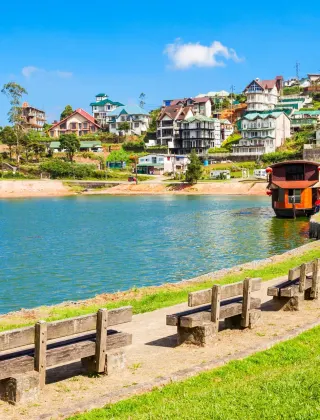
Gregory Lake covers 225 acres (about 91 hectares) at the edge of the town centre. It was created in 1873 when Governor Sir William Gregory authorised the damming of the Thalagala stream and is named directly after him. The surrounding Gregory Park has pine trees, manicured lawns, and views across the water to the surrounding hills. Rowboat and pedal boat hire is available, along with jet skis, horseback riding along the perimeter track, and cycling paths.
The lake is a relaxed afternoon stop rather than a major attraction in its own right. The combination of the cool temperature, the pine-scented air, and the park setting gives it a character unlike any lakeside in lowland Sri Lanka. It is the place where the "Little England" comparison is most convincing.
Victoria Park
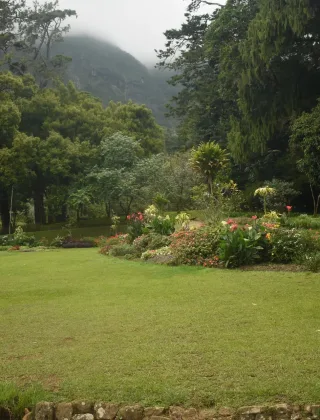
Victoria Park is a 27-acre formal garden in the centre of town, with rose beds, dahlia borders, and seasonal flowering plants. The Nanu Oya River runs through it. Entry for foreign visitors is a small fee (approximately LKR 500 to 1,000; confirm the current rate at the gate as Sri Lanka has been revising park fees). Best flowering periods are March to May and August to September.
The park is a reliable birdwatching spot. Three Sri Lankan endemic species are seen here regularly: the Yellow-eared Bulbul, the Sri Lanka White-eye, and the Sri Lanka Scimitar Babbler. Between November and April, winter migrants including the Kashmir Flycatcher and Indian Blue Robin also pass through. Birders with a few hours can combine a Victoria Park walk with a visit to the nearby Hakgala Botanical Gardens (7 km from town) for a wider range of endemics.
Horton Plains and World's End
Horton Plains National Park is about 30 kilometres from Nuwara Eliya, roughly a 1 to 1.5-hour drive by car or tuk-tuk on a paved road. It is one of the most visited day trips from the town and should be planned carefully around the weather.
The entry fee for foreign visitors is approximately USD 30 to 40 per adult including taxes and service charges (bring LKR cash; cards are not accepted at the gate). The main trail is a 9.5-kilometre circular route that takes 3 to 4 hours and passes both World's End and Baker's Falls.
World's End is a sheer escarpment on the southern edge of the plateau where the land drops approximately 880 metres to the valley below. On a clear day the view extends to the southern lowlands and, in very clear conditions, all the way to the coast. The critical practical point: clouds roll in from around 9am most days and frequently obscure the view entirely for the rest of the morning. The park opens at 6am. Arrive at the gate by 6am to reach the viewpoint by 7 to 7:30am. Any later and you risk arriving to find nothing but white cloud.
Baker's Falls, named after Samuel Baker, drops 20 metres and sits on the return leg of the circuit. The path from the car park to World's End and back to Baker's Falls is well-maintained and suitable for most fitness levels. Wear light layers as the plateau can be cold and windy even when the lower town is warm.
Adam's Peak (Sri Pada)
Adam's Peak, 71 kilometres from Nuwara Eliya, stands at 2,243 metres and is one of the most significant pilgrimage sites in South Asia. At the summit is a rock formation approximately 1.8 metres long that is sacred to four religions simultaneously: Buddhists identify it as the footprint of the Buddha; Hindus call it the footprint of Shiva; Muslims hold that it is the footprint of Adam, who stood here on one foot for a thousand years after his expulsion from paradise; Portuguese Christians in the 16th century claimed it as the footprint of St. Thomas.
The pilgrimage season runs from December through May. The most popular ascent begins at Nallathanniya (Dalhousie), reached via Hatton, and climbs approximately 5,500 steps to the summit. The climb takes 2 to 4 hours depending on fitness and crowd conditions. April is peak season. Outside the December to May window, the mountain is frequently cloud-covered and the climb is not recommended.
Strawberry Farms and Local Food
Nuwara Eliya's cool climate supports crops that cannot grow in the tropical lowlands. The town is Sri Lanka's main source of leeks, carrots, potatoes, and cabbages, and the produce markets in town reflect this. The main market on New Bazaar Street is worth a walk for the range of highland vegetables and fresh herbs not found elsewhere on the island.
Strawberry farming is concentrated in the Ambewela and Ragala areas a few kilometres outside town. Pick-your-own farms operate during the cooler months, broadly October through April, though farms sell fruit year-round. Fresh strawberries, strawberry jam, and juice are sold at roadside stalls entering town on the Kandy road. This is a genuine local product, not a tourist contrivance.
For the colonial food experience, afternoon high tea at the Hill Club (full service, silver pots, small sandwiches, scones) or the Grand Hotel is the specific Nuwara Eliya thing to do. Both venues require a reservation for the tea service.
The April Season
In April, centred on the Sinhala and Tamil New Year (around 13 to 14 April), Nuwara Eliya transforms. The town fills with domestic tourists for two to three weeks. The main events are the flower show (held at Victoria Park), the horse racing season at the Nuwara Eliya Racecourse, and car rallies. The Nuwara Eliya Racecourse is one of the highest horse racing venues in the world at 1,868 metres and the only functioning racing venue in Sri Lanka. Races during this period draw large crowds.
If you want to attend the racing or the flower show, April is the time to come. If you want a quiet visit to Horton Plains and the tea estates, avoid April. Hotels in town raise prices significantly during this period and book out weeks in advance.
Getting to Nuwara Eliya
- From Kandy by road: Approximately 2.5 hours (75 km) by private car, with the option to stop at a tea estate or the Ramboda Falls viewpoint on the way. This is how most guests make the trip
- From Ella by road: Approximately 2 hours by private car
- From Colombo by road: Approximately 5 hours (172 km) by private car
- By train, a budget alternative: The nearest station is Nanu Oya, approximately 8 kilometres from town; tuk-tuks and taxis meet arriving trains for the 15-minute ride in. The train from Kandy to Nanu Oya takes 3.5 to 4 hours, climbing over 1,200 metres through tea estates and highland mist. Note: as of early 2026 the hill country line (Kandy to Badulla via Nanu Oya and Ella) is suspended due to Cyclone Ditwah track damage; verify current service status at railway.gov.lk before planning rail travel to Nuwara Eliya
The drive from Kandy to Nuwara Eliya via the main A5 road is worth taking slowly. The road passes through Ramboda, where you can stop at the Ramboda Falls viewpoint (one of Sri Lanka's tallest at around 109 metres), and through the Mackwoods and Damro Labookellie estates. This stretch of road is often mentioned by visitors as one of the more enjoyable drives on the island.
Hill Country Circuit
Nuwara Eliya sits roughly midway between Kandy and Ella on the hill country circuit that most visitors follow through the central highlands. A practical three-to-four-day route runs Kandy to Nuwara Eliya (with a Horton Plains morning on the second day), then continues to Ella by road or, when the hill country train is running, by the scenic rail route. Note: as of early 2026 the hill country line is suspended due to Cyclone Ditwah track damage; check railway.gov.lk for current service status before planning the rail connection. The same route in reverse works equally well.
CeylonExplora arranges private drivers and guides for the hill country circuit. If you want the Horton Plains entry fees and logistics handled in advance, or a driver who can stop at estate viewpoints along the A5, get in touch to plan the route.


From Fellow Travellers
Comments
No comments yet
Been here, or planning your own trip? Share your experience below and help the next traveller.
Leave a Comment
Comments are reviewed before publishing. No links, please. Email is optional and never shown.