

How the Southern Coast Works
Sri Lanka's southern coast runs roughly 75 kilometres from Galle in the west to Tangalle in the east, and the six towns along it are more different from each other than most first-time visitors expect. This isn't one long uniform beach. Unawatuna is a sheltered swimming cove. Weligama is a wide, sandy-bottomed surf nursery. Mirissa is a working whale-watching harbour with a party strip attached. Hiriketiya is a tiny horseshoe bay that surfers found and a wellness crowd followed. Tangalle splits into three beaches with three different personalities within a few kilometres of each other. Hikkaduwa, off to the northwest, is the oldest and most built-up of the group, running on the oldest, most established tourist infrastructure on this coast, dating to the 1970s.
Season matters as much as location. The south coast is at its calmest from November to April, outside the southwest monsoon. The southwest monsoon runs from May to October, bringing swells that make most of these beaches unsafe for casual swimming. The water turns rough enough in June and July that even locals stay out. Experienced surfers who know these specific breaks seek out exactly these conditions; it is not a season or a swell for a beginner to enter without local knowledge. Surfers and swimmers effectively use the coast at opposite times of year, and Weligama and Hiriketiya are the exceptions worth knowing about: their bay geometry keeps them partly surfable even when the open beaches further along the coast are blown out.
This is also why the south coast and the east coast (Arugam Bay, Trincomalee, Pasikuda) never quite work as a single trip without planning around the calendar. Sri Lanka effectively runs two opposite seasons at once: the southwest monsoon that governs everything in this guide roughly November to April, and a northeast monsoon on the other side of the island that flips the calendar, leaving the east coast at its best from around April or May through September, with October a genuinely unpredictable transition month on that side as the northeast monsoon builds. If your trip spans both coasts, build the itinerary around whichever season you're actually travelling in rather than assuming one coast's good weather applies to the other.
The sections below run west to east from Galle, in the order you'd actually drive them. Hikkaduwa lies northwest of Galle, on the opposite side, so it's listed separately at the end as its own trip.
Unawatuna

Unawatuna is a compact, crescent-shaped bay about 6 kilometres from Galle, short enough that it functions more like a beach suburb of the city than a standalone destination. The bay itself is small, around a kilometre end to end, roughly a 15-minute walk along its full length. What makes it distinct from Weligama and Mirissa further east is protection: a natural reef and the Rumassala headland at the western end block most of the open-ocean swell before it reaches the sand, which is why Unawatuna is consistently the pick for families and weaker swimmers among the three main beach towns. The water here stays calmer, longer into the year, than almost anywhere else on this stretch of coast.
That same reef used to be the beach's other headline draw, and it no longer is. The coral was badly damaged by the 2016 El Nino bleaching event, and recent visitor reports describe patchy, mostly dead coral rather than a healthy reef. Snorkelling tours still run and are still sold, but go in with low expectations rather than the postcard version. A local restoration project is working on it, but there is no evidence yet of a meaningful recovery.
What the bay does still offer is a genuine diving base. Several PADI five-star dive centres operate directly from the beach, running boat trips to wreck sites nearby: the SS Rangoon at around 30 metres, the SS Orestes at around 22 metres, a smaller wreck locally called the Galle Ship Wreck at around 18 metres, and a few others. These are boat-based trips, so they stop almost entirely once the monsoon swell picks up from May.
Above the bay, the Rumassala headland is worth the climb on its own. The Japanese Peace Pagoda, built in 2005 by Buddhist monks of the Nipponzan Myohoji order, sits on the hill with views over the ocean, the jungle, and Galle Fort in the distance. It's a 15 to 20 minute walk from the western end of Unawatuna beach, steep in places, best done in the early morning or late afternoon when the heat and light are both easier.

Keep going over that same headland and you reach Jungle Beach, a smaller, more sheltered cove. Correct the record here: this is not a 10-minute stroll. It's a 30 to 45 minute walk over the headland via the Peace Pagoda trail, and the path is genuinely steep and rough in parts. If that's not appealing, the access road down takes about 30 minutes door to door by tuk-tuk or car and costs roughly LKR 350 to 400 for a tuk-tuk, or you can catch one of the boat transfers that run from Unawatuna beach from around mid-morning. There's no entry fee for the beach itself; leaving a vehicle at the top adds a small LKR 100 parking charge. Once you're there, don't expect a hidden secret: it fills up from mid-morning as boat tours arrive and stays busy until around 3pm, so aim for early (by 8:30am) or late (after 4pm) if quiet is the point. Snorkelling here is calmer than the main bay but still patchy rather than pristine, with a rocky reef at both ends of the cove holding parrotfish, wrasse, sergeant majors, and the occasional turtle. Bring your own water and sunscreen; facilities amount to two small cafes.
Unawatuna's food scene is casual and seafood-forward rather than fine dining. Several feet-in-the-sand restaurants along the beach serve a seafood and Asian-fusion menu, and one of them runs the area's best-known organised event, a Saturday night beach party with live music. More relaxed, low-key spots sit right on the sand too, and a short drive out toward Talpe brings you to a beachfront restaurant known for sunset views and wood-fired pizza, though reviews on the food itself are mixed. For something cheap and unpretentious, a roti stall on the walk down to the beach does rustic roti at low prices.
Evenings here are relaxed rather than loud: a Saturday beach party is the one fixed event, and a few beach bars run as low-key hangouts after dinner. It's not a club scene, which suits Unawatuna's character as a family-friendly base more than a nightlife destination.
Accommodation is where Unawatuna pulls ahead of the other south-coast towns: it has the most developed hotel scene of the group, and most of it sits directly on or within a couple of hundred metres of the sand. Simple guesthouses run roughly $15 to $30 a night; mid-range and boutique hotels run $60 to $160; and at the top end, Cocobay Unawatuna, a boutique four-star with its own stretch of private beach and views across to Galle Fort, anchors the higher tier from around $180 a night upward (rates as of August 2026, check current pricing before booking). If you want a hotel that's actually on the sand rather than across the road from it, Unawatuna has more of those than Mirissa or Weligama, worth telling us early if beachfront access matters more to you than location within town.
Season changes this beach more than most. December through March is peak: calmest seas, clearest water, and the highest prices and crowds, with the week around Christmas and New Year commonly running double or triple November's room rates and needing 2 to 3 months' advance booking if you want a specific place. Early December, before that spike, is a reasonable sweet spot. May through October brings the southwest monsoon: rougher seas that curtail the boat-based diving and snorkelling trips, more rain (May and June are the wettest months), but also a quieter, cheaper beach if you don't need calm water.
Unawatuna is the right call for families, weaker swimmers, and anyone who wants a beach with a working village around it rather than an empty stretch of sand. It's the wrong call if you want to surf (Weligama is a short drive away and does that job properly), if you want a healthy reef to snorkel, or if you dislike crowds: the most consistent complaint in visitor reviews is that the bay itself has become genuinely busy and commercially dense, even though touts here are reported as less aggressive than at many other beach resorts. It's also a strong opening or closing stop on a private southern-coast itinerary, close enough to Galle to pair easily with the rest of the route.
Weligama

Weligama is roughly 30 kilometres east of Galle, about 30 minutes by road, and it exists for one reason: it's the easiest place in the country to learn to surf. The bay is wide, about 1.5 kilometres across, with a sandy bottom rather than reef or rock underneath, and it produces soft, slow-breaking waves generally in the 2 to 3 foot range. That combination, low injury risk from the sandy floor, forgiving wave power, warm water year-round, is why Weligama has become the most concentrated surf-school hub in Sri Lanka, with more than 50 schools now operating along the bay. Lesson rates typically run LKR 3,300 to 5,000 per hour or higher, though pricing varies enough by school that it's worth confirming directly before booking; board rental alone runs around LKR 800 an hour.
Weligama's other signature sight, the stilt fishermen, is worth understanding accurately rather than romantically. The practice genuinely dates to the years around World War II, when food shortages and overcrowded fishing grounds pushed local fishermen to plant poles in the shallows and fish from a crossbar seat above the water, out of reach of the crowd below. It spread along a roughly 30 kilometre stretch of this coast, from Unawatuna through Ahangama, Koggala and Midigama to Weligama, and it's a real regional tradition, not something invented for cameras. But it's also, today, almost entirely a paid photo opportunity rather than a livelihood. The 2004 tsunami damaged fishing grounds, catches of small herring and mackerel have become commercially unviable, and the men you'll see posing on poles along the main tourist strip are typically doing it for a tip, commonly LKR 100 to 500 per photo, rather than fishing for income. It's not a scam, but it isn't a candid glimpse of daily life either, and it's worth knowing that before you photograph it.
Just offshore from the beach sits Taprobane Island, a small palm-fringed islet you can wade out to at low tide. It was built as a private retreat in the 1920s by a French count and now operates as an exclusive whole-island villa rental, but even if you're not staying there, it's a striking landmark from the sand. Inland, Weligama Lagoon offers calmer paddling: kayak tours through mangroves where you'll see kingfishers, monitor lizards, and crabs, usually run early morning or late afternoon.
For food, one standout restaurant does ocean-view dinners with a Sri Lankan and international menu in a beachfront setting. A handful of daytime cafes (specialty coffee, smoothie bowls) turn into rooftop bars by evening, and there's a bar literally on the sand for the surf crowd. None of this is a party scene in the Mirissa sense: Weligama's evenings run relaxed, cafe-and-sundowner territory rather than club energy, and the town draws a steady year-round crowd of surfers and remote workers as a result.
Accommodation ranges from simple surf lodges on the beach, roughly $15 to $30 a night, up to the Weligama Bay Marriott, the one true beachfront five-star option directly on this bay. A short drive inland, Malabar Hill, a boutique villa resort on a former cinnamon estate with private plunge pools, and Cape Weligama, a five-star clifftop resort on the headland toward Mirissa, are both often assumed to be on Weligama's surf bay because of the name association, but neither sits directly on it, worth flagging to us if beachfront specifically matters when we're booking your stay.
Season affects Weligama differently than the swimming beaches. November to April is the main tourist season: calmer, more consistent 2 to 5 foot waves, and the most crowded lineups, sometimes over 100 surfers in the water on a peak day. What's less obvious is that the bay doesn't fully shut down in the southwest monsoon between May and October the way most of this coast does. The same orientation that makes it beginner-friendly also means it can hold a rideable wave, sometimes a bigger one, 3 to 6 feet, through the monsoon months, which suits confident beginners and intermediates rather than complete first-timers. It's rougher, wetter, and less consistent, but it isn't dead.
Weligama is the right choice if you want to learn to surf, want a relaxed cafe scene, or want an easy base with harder breaks (Midigama, Ahangama, a spot locally called SK Town) a short drive away. It's the wrong choice if you actually want a quiet place to swim: with dozens of learners on boards in the water, especially in peak season, the main bay is not a relaxing swim, and several sources point swimmers toward Jungle Beach, near Unawatuna, as the nearby alternative without the board traffic.
Mirissa

Mirissa is roughly 35 kilometres east of Galle, about 40 minutes by road, and it's the town most visitors on this coast build a day, or several, around. But it's more than the whale-watching harbour it's usually reduced to. The beach itself is a roughly 2 kilometre crescent of soft, mostly rock-free sand, and it isn't uniformly swimmable: the calm, protected section is specifically near Parrot Rock, with gentler waves and shallower water suited to all ages, while the far side of the bay has rocks, sea urchins, and real waves, and isn't a swimming beach. Know which stretch you're on before you go in.

Parrot Rock itself is a small tidal islet sitting about 50 metres offshore in the middle of the bay, not a permanent walk-out landmass. It's only safely reachable at low tide, over a short wooden walkway followed by stone steps to the top. The climb is easy and genuinely kid-friendly in the right conditions, but the walkway is slippery when wet and the steps are exposed, and at high tide the crossing means wading through waist-deep water, which isn't worth attempting. From the top you get a full view of the bay's crescent. Go at low tide, ideally morning or evening rather than midday, and skip it entirely during monsoon weather, when the path turns to mud.

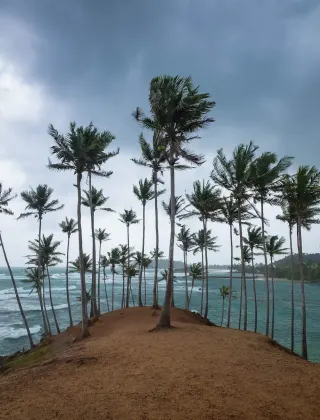
Ten to fifteen minutes' walk west along the coast from central Mirissa, essentially a continuation of the same beach strip rather than a separate trip, is Coconut Tree Hill: a red-clay headland planted with a coconut grove, growing at dramatic angles above the turquoise water. It's one of the most photographed spots in Sri Lanka, and it's been drawing attention for longer than Instagram has existed: the naturalist Ernst Haeckel described the same red cliffs in 1881, writing that they "seem to burn like coal" at sunset. Go at sunrise, roughly 5:30 to 7am, if you can manage it, both for the light and because the site is genuinely packed from mid-morning onward through the rest of the day. It's privately run as a working coconut estate, and pricing has shifted over the years, sometimes free with a small parking charge, sometimes a modest entrance ticket, so treat any specific figure as unconfirmed and expect to pay something small on arrival.
Whale watching is Mirissa's actual claim to fame, and the core facts hold up: the season runs November to April, with the most reliable sightings December through March, boats leave Mirissa Harbour around 6:00 to 6:30am because afternoon seas are rougher, and blue whales are the headline draw, with sperm whales as the reliable secondary sighting. A typical trip runs 3.5 to 5 hours and costs from roughly $64 per person upward, with smaller, better-run boats charging more than the cheapest mass-market option. What's worth knowing before you book: Mirissa's rapid rise as a global whale-watching destination has come with a real, well-documented welfare problem. In peak season it's common for 10 to 25 boats to converge on and follow a single blue whale at once, and Sri Lanka does have a regulatory framework (a minimum 100 metre approach distance, engine shutdown within 1,000 metres) that is widely reported as weakly enforced. If this matters to you, look for operators that explicitly cap boat numbers near a single animal and run smaller passenger groups rather than the cheapest large boat on the harbour.
For food, one restaurant sits directly on the beach and shifts from a Sri Lankan and Western dinner spot into a lively evening bar. A short walk back from the sand, a roti shop that started as a roadside cart in 2009 is now a genuine local institution for cheap, huge-portion rotis and kottu. One health-food cafe does smoothie bowls and some of the better coffee on this coast, and another spot between Parrot Rock and Coconut Tree Hill does a plant-based menu with ocean views.
Mirissa has the liveliest nightlife of the towns on this stretch, consistently and by a clear margin over Unawatuna and Hiriketiya. Beach bars turn into open-air dance floors after dark, and one bar just outside town, housed in a restored roughly 200-year-old Dutch colonial building, runs craft cocktails alongside live music several nights a week. The trade-off is noise: beachfront bar music commonly runs until 2 or 3am, so if you want to sleep, ask us to place your room a short walk back from the main strip rather than in the middle of it.
On accommodation, the read you had is right, with some nuance. True five-star, branded, directly-on-the-sand hotels are genuinely scarce in Mirissa; one independent reviewer described the luxury offering here as "pretty minimal" compared with somewhere like Bentota. What Mirissa has instead is a strong layer of guesthouses and boutique villas, simple rooms from roughly $15 to $30 a night, boutique stays from around $50 to $120, with a handful of better-regarded beachfront boutique options on quieter stretches of the bay. If you specifically want branded five-star and are willing to give up direct beach access, a restored cinnamon estate operating as a five-star hilltop retreat is a genuine option, but it sits on a hilltop with coastal views rather than on the sand. The nearest true beachfront branded resort is, again, the Weligama Bay Marriott, a short drive west in the neighbouring bay.
Season swings Mirissa hard. November to April is calm, dry and the peak window for both whale watching and swimming, with December and January the busiest and most expensive weeks. May through July is the other extreme: seas are rough enough that whale-watching boats generally don't run at all in those three months. August to October sees a partial, weather-dependent return, subject to sea conditions and often a minimum passenger count before a boat will go out.
Be realistic about the honest downsides too. General Sri Lanka safety guides specifically flag Mirissa, alongside Hikkaduwa, as a spot where petty theft is more common than in quieter areas, and while there's no single dedicated incident report behind that, it shows up consistently enough across sources to take seriously: don't leave valuables unattended on the beach. Rip currents are a real, documented hazard on the exposed side of the bay, and lifeguard coverage is thin and inconsistent. None of this should keep you away, but it's worth knowing going in, alongside the whale-watching crowding issue above.
Hiriketiya
Hiriketiya is a small horseshoe-shaped bay near Dickwella, about 15 kilometres from Tangalle and roughly 30 kilometres east of Mirissa, and its whole character comes from the shape of that bay. It funnels swell in while the headlands on both sides block wind, which produces a cleaner wave than the open beach breaks elsewhere on this coast and keeps the water surfable across more of the year than most south-coast spots manage. The bay splits cleanly by ability: a sandy, forgiving beach break on one side suited to beginners and intermediates, and a fast, shallow, urchin-studded left-hand point break on the other, starting near a beachfront bar at that end of the bay, for upper-intermediate and advanced surfers only. Both sides are technically left-handers, a quirk of how the bay is angled, worth knowing if you're trying to plan which peak to paddle out to.
This is not, despite the sheltered shape, a still-water swimming beach. The surf break sits right at the mouth of the cove, so there's almost always some wave activity in the water, and while the inner bay is calm enough for comfortable swimming most days, rip currents do occur and lifeguard presence is inconsistent. Ask a local surfer or instructor about conditions before swimming out past where you can stand.
Hiriketiya's other identity, alongside surf, is wellness. Several yoga studios and retreat operators run regular classes or programmes from shalas around the bay, and the crowd here skews younger and more health-conscious than anywhere else on this stretch: acai bowls, specialty coffee and vegan-friendly menus are the norm rather than the exception. One cafe combines that wellness-cafe style with Sri Lankan hoppers; another is repeatedly cited as having the best coffee in the bay; a third functions as cafe, bar, and social hub in one, and is the most-cited beachfront sundowner spot.
Don't expect the "chilled, empty bay" reputation Hiriketiya still carries in a lot of older write-ups. Multiple current sources are direct about this: it is no longer the quiet secret it was even a few years ago. There's a real evening scene now, the cafe-bar-social-hub mentioned above and a well-regarded cocktail bar both draw a crowd, busiest Friday and Saturday, quieter mid-week, and it thins out noticeably in the May to October off-season. It's still meaningfully calmer than Mirissa's party strip, just not silent.
Accommodation here leans boutique rather than resort-scale, and there's no branded four- or five-star hotel in the bay. Simple guesthouses run roughly $16 to $50 a night; the top end is independent hillside boutiques like Salt House and Jasper House, both small, well-regarded, and set on the hills above the bay rather than on the beach, from around $120 a night. The busier, more social stays near the point break are explicitly not the choice if you want quiet. True beachfront rooms are genuinely limited here, the cove itself is small and mostly taken up by surf-rental stands and cafe seating, so most well-reviewed stays are a short walk or tuk-tuk ride down to the sand rather than directly on it.
Before around 2010, Hiriketiya was a fishing and coir-rope village with essentially no tourism. The shift to what it is now happened mostly between 2018 and 2025, and it's been fast enough that several current guides now flag the opposite problem to the one it had a decade ago: more shops, cafes, hostels and bars than the small cove can comfortably sustain. There is a structural limit here that doesn't exist at Unawatuna or Hikkaduwa, though: the bay is small and fixed, so there's simply no more waterfront left to build on, which caps how much further it can sprawl.
Hiriketiya suits solo travellers, intermediate-to-advanced surfers on the point break, beginners on the beach-break side, and anyone drawn to the yoga and wellness scene. It's a poor fit for families with young children, since beach space is dominated by surf infrastructure rather than open sand, and it's not a swimming-first destination even though it looks like one from a photo.
Tangalle

Tangalle is approximately 75 kilometres east of Galle, roughly an hour to an hour and a half by road, and unlike the beaches further west it isn't one stretch of sand: it's a cluster of distinct beaches with genuinely different characters, close together but not interchangeable.
Medaketiya Beach
Medaketiya is the long, straight beach immediately east of Tangalle town, and it's where most visitors actually stay, lined with guesthouses and a run of restaurants. Be clear-eyed about the water here: it shelves steeply and carries dangerous currents in places, and it's a better beach for walking than for swimming, even in the dry season. One Tripadvisor review sums it up in its title: "Nice beach, bad swimming." For food, a run of beachfront cafes and seafood restaurants line Medaketiya Road, the usual fresh-catch-of-the-day menu repeated up and down the strip.
Goyambokka Beach
Goyambokka is a sheltered cove roughly 2 to 4 kilometres west of Tangalle town, protected by a reef and headland, and it's the calm, family-friendly counterpart to Medaketiya's rough water, current-free and shallow enough to be one of the safer swimming spots in the area. Two high-end resorts anchor this stretch of coast: the Anantara Peace Haven Tangalle Resort, a 152-room five-star property with private-pool villas, sits at Goyambokka Estate itself, from roughly $280 a night upward depending on room category and season; Amanwella, an Aman resort with a private plunge pool on every suite, sits on the adjoining beach at Godellawela, sometimes called Silent Beach, a short distance away rather than directly on Goyambokka, priced well above the Anantara tier, get a live quote rather than relying on any figure online. Smaller, more affordable guesthouses exist too, generally from around $40 a night, close to the sand. Overall the cove reads as quieter and less developed than Medaketiya despite the big resorts nearby. Rates as of August 2026; verify current pricing before booking.
Rekawa Beach
Rekawa, roughly 10 kilometres east of Tangalle town, is a long, quiet, largely undeveloped stretch backed by lagoon and mangrove, and it's Sri Lanka's most documented sea turtle nesting site: five species nest here, Green, Hawksbill, Leatherback, Loggerhead and Olive Ridley, with green turtles, the most common of the five, nesting most heavily from April to July, though nesting by one species or another occurs across a wider window and hatchlings emerge as late as September. The Turtle Conservation Project has run a community-based nest protection programme here since 1995, now managed day to day by the local group Nature Friends of Rekawa.
A real visit works like this: you arrive at the Visitor Centre in the evening, generally between 5 and 8pm, and wait, sometimes an hour, sometimes several, until a nest protector patrolling the beach radios that a turtle has come ashore. A guide then walks your group to her. Rules are strict and enforced for good reason: no flash photography or white light of any kind, guides carry only red-filtered torches since turtles can barely see red light; no touching; no approaching until the turtle has begun laying and is committed to the process; no alcohol or smoking on the beach. There is no guaranteed sighting; this is wild animal behaviour on its own schedule, not a show. Expect to pay in the range of LKR 1,000 to 2,000 for a foreign adult, prices vary by which of two locally-run programmes you go through, so confirm the fee on arrival rather than relying on any figure quoted online. Beyond turtles, Rekawa's mangrove-fringed lagoon is a genuine birdwatching spot, home to waders and migratory species as well as water monitors, and some operators run separate lagoon boat trips outside the evening turtle watch.
Away from the beaches, Tangalle also holds a genuine cluster of high-end stays that the rest of this coast doesn't really match outside the hilltop cinnamon-estate retreat mentioned for Mirissa: alongside the two resorts above, The Last House, a small boutique hotel near Mawella Beach built as the final residential project of Geoffrey Bawa, Sri Lanka's most influential architect, and a handful of other properties run private-pool beachfront villas on the Mawella side.
Hikkaduwa (Northwest of Galle)
Hikkaduwa sits 17 kilometres northwest of Galle on the A2 toward Colombo, on the opposite side of Galle from every other beach in this guide, so it's a separate trip rather than a stop on the same route. Many visitors actually reach it directly from Bandaranaike International Airport, roughly 140 kilometres and 2 to 2.5 hours by expressway, without going anywhere near Galle at all.
The reason to come is the reef. Hikkaduwa National Park protects Sri Lanka's first marine protected area, holding over 60 species of hard coral across 31 genera, sitting around 200 metres offshore in water 1 to 5 metres deep, shallow and close enough to snorkel without a boat. The 1998 El Nino bleaching event was severe here, cutting live coral cover from roughly 47 percent to 13 percent, and a formal government restoration programme (coral nurseries grown on cement blocks and transplanted onto the reef) has been running since, though full recovery to pre-1998 condition isn't realistic and reviewers should expect a damaged but still worthwhile reef, not a pristine one. Glass-bottom boat tours run from near the town centre, typically around $18 per person for roughly two hours including guided snorkelling; know going in that the "glass bottom" is usually a small viewing panel rather than a full glass hull, and that turtle sightings, while common, aren't guaranteed on any given trip.
Speaking of turtles, Hikkaduwa has its own, and it's a different experience from Rekawa's nesting programme. These are resident green and hawksbill turtles that feed in the shallows just off the beach year-round, visible while snorkelling or sometimes just wading. Locals sell bags of seaweed for hand-feeding them close to shore, which is a popular activity but worth a note of caution: enforcement of "don't touch" signage is minimal, and feeding wild turtles to draw them in is an animal-welfare grey area that some ethical-travel guides caution against. Early morning or the 4 to 6pm window, when turtles return to feed as the beach quiets down, are the best times to see them regardless of whether you choose to feed them.
Hikkaduwa also has surf, at Narigama, a roughly 4 kilometre stretch of beach break running parallel to the coast road with several peaks, generally mellow and forgiving, good for beginners and improvers through most of the dry season, with the cleanest, most consistent conditions typically around March. Larger swells run May to October; November to April brings cleaner, more organised sets, the same pattern as the rest of the coast but shifted here toward better swimming and snorkelling safety specifically in the November to April window, since the sea also gets rougher and murkier for snorkelling in the monsoon months, not just harder to surf.
Hikkaduwa has the longest continuous tourism history on this coast, dating back to the 1970s, and it shows in both directions: it has the most established bar and nightlife scene of any town in this guide, and it also reads as more of a worn, dense resort strip than the newer, more curated scenes at Hiriketiya or the crescent setting at Mirissa. A handful of beachfront bars run through the evening, one is known for full-moon parties, its actual signature event rather than nightly high-energy clubbing, another for Friday-night live bands and DJs. The main coast road runs directly through town, which is exactly why it's so easy to reach and also why traffic and noise are part of the package here in a way they aren't at the smaller towns further south. If quiet evenings matter more than nightlife, this isn't the town to base yourself in.
Accommodation spans simple guesthouses around Narigama, roughly $12 to $30 a night, through to Hikka Tranz by Cinnamon, a 150-room four-star beachfront property from the well-established Cinnamon Hotels chain, generally $60 to $170 a night depending on season, with a handful of boutique options in between. Rates as of August 2026; verify current pricing before booking. Peak season here runs December through March, when Hikkaduwa's surf and its snorkelling conditions happen to peak together, an overlap most other towns on this coast don't get, before quieting through the low season from May to November.
Beach Safety on the South Coast
Several practical points apply across the whole coastline:
- Monsoon season: May to October. Most south-coast beaches are unsafe for casual swimming during this window. Waves reach a size that even experienced swimmers avoid. If you are on the south coast in June or July, the sea is for looking at, not getting into
- Rip currents: A hazard at exposed beaches including Mirissa, Weligama's outer bay, and the open stretches of Tangalle (Medaketiya especially). They are most dangerous in the hour after rain and during any period of increased swell. Swim in flagged zones where they exist, and where there are none, treat the absence of a flag as no information at all, not a green light
- Lifeguard coverage: Inconsistent. Mirissa has a Coast Guard presence; most other beaches, including the calmer-looking coves like Hiriketiya and Goyambokka, have no reliable patrol. Do not assume someone is watching
- Flag systems: Used at Unawatuna and Mirissa but not at most other beaches. If there are no flags, you are reading the conditions yourself
- Petty theft: General safety guides for Sri Lanka's south coast specifically flag Mirissa and Hikkaduwa as spots where opportunistic theft is more common than average. Don't leave valuables unattended on the sand
- Whale-watching boats: Sri Lanka has approach-distance regulations for whale watching that are inconsistently enforced; if the welfare of the animals matters to you, book with an operator that visibly limits how many boats crowd a single whale rather than the cheapest option on the harbour
- Turtle watching at Rekawa: Go through the organised evening programme with a guide rather than walking the beach alone at night. No flash photography, no touching, no guaranteed sighting
Getting Along the Coast
The straightforward way to cover this coast is a single private driver for the whole route, Galle through to Tangalle, with stops built in wherever you actually want time: an extra hour at Coconut Tree Hill for sunrise, a diversion to Rekawa for the evening turtle watch, a separate day up to Hikkaduwa since it sits on the opposite side of Galle from everywhere else in this guide. That's the arrangement CeylonExplora sets up most often for this stretch: one vehicle, one driver, a route built around the towns and timings that matter to you rather than a fixed bus timetable. Get in touch and we'll plan it around your dates.
If you're covering some of this ground independently, here's what the road actually looks like. The main A2 coast road connects Galle to Matara and then to Tangalle, and is in reasonable condition throughout, though it runs directly through the middle of Hikkaduwa and can be slow there. Tuk-tuks cover short hops between beaches; buses connect all the main towns but require changes and take significantly longer than a direct car. Reaching Hiriketiya specifically requires a short final leg regardless of how you travel: buses and trains stop on the main coast road at the Dickwella junction, with a 10-minute walk or a short tuk-tuk ride down into the bay itself.
The Colombo to Matara railway line is the coastal train, which runs within sight of the sea for much of the stretch between Colombo and Galle. It does not serve the beaches east of Matara directly, and Hikkaduwa itself is usually best treated as its own day rather than folded into the same run down to Tangalle, worth flagging when we're mapping out your dates.




From Fellow Travellers
Comments
No comments yet
Been here, or planning your own trip? Share your experience below and help the next traveller.
Leave a Comment
Comments are reviewed before publishing. No links, please. Email is optional and never shown.