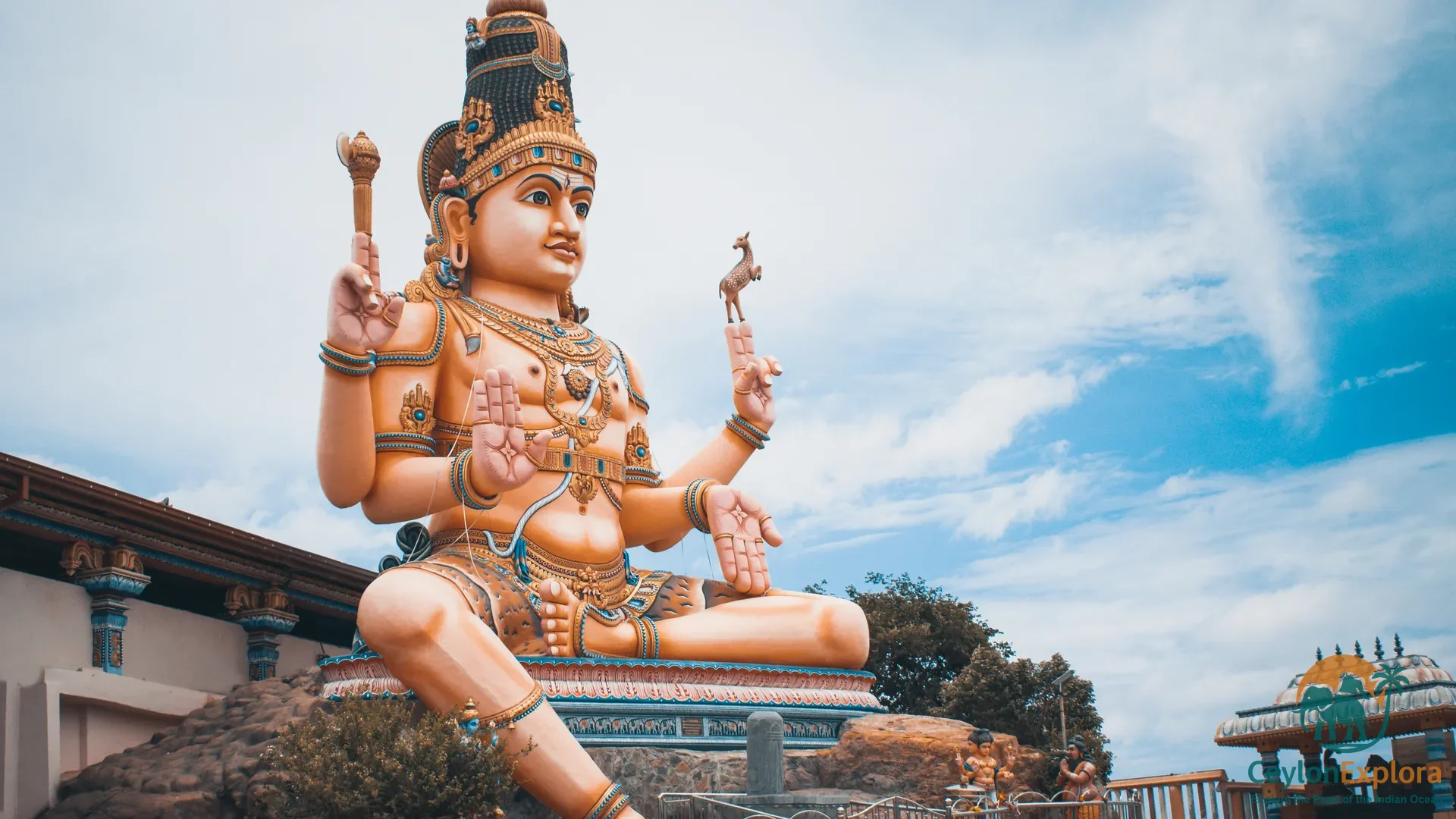

What Trincomalee Is
Trincomalee sits on Sri Lanka's northeast coast on a peninsula that divides its inner and outer harbours. The natural harbour here covers 1,630 hectares of water and ranks among the largest deep-water natural harbours in the world, making it historically contested by every maritime power that passed through the Indian Ocean. The Portuguese built a fort here in 1624, the Dutch took it in 1639, and the British held it from 1796 until independence in 1948. The harbour's value was military and commercial. The surrounding coast's appeal, now that the civil war is over and the east has been open to visitors since around 2009, is something different: long, quiet beaches, a nationally protected reef with blacktip reef sharks, and some of the best whale sightings in the Indian Ocean region.
Trincomalee is the east coast, and the east coast operates on the opposite seasonal pattern from the south. April to September is the dry window here. The southwest monsoon that batters Mirissa and Galle in June and July brings calm, flat seas to Trincomalee. When the south coast closes, the east opens.
Practical Information
Best time to visit: April to September. May through August is the most reliable window for calm seas, snorkelling, and whale watching. The northeast monsoon (October to January) brings rough weather and closes Pigeon Island boat trips
Getting there from Colombo: By private car with a driver, 5 to 6 hours (257 km via Dambulla), with the option to break the journey at Sigiriya or Habarana on the way. Budget alternatives: overnight train approximately 8 hours (departs Colombo Fort around 21:30) or bus approximately 7 hours.
From Anuradhapura: 3 to 3.5 hours by road; an easy same-day hop with your driver after a morning in the sacred city
Time needed: Two full days covers the main sites. Three to four days allows a whale watching trip and time to settle in properly
Getting around: With a car and driver, beach, temple and harbour stops are covered as part of your day. Tuk-tuks are available for short independent hops; agree the fare first. Boat tour touts at Nilaveli can be aggressive; fix the Pigeon Island price before getting in, or have your driver or tour operator arrange the boat in advance
Uppuveli Beach
Uppuveli is 5 to 6 kilometres north of Trincomalee town, about 10 minutes by car. The beach runs roughly 2 kilometres, with guesthouses, dive shops, and restaurants along the back of the sand. It is the more social and convenient base of the two main beaches: closer to town, more food options, and with a lively evening atmosphere by east-coast standards. Some sections of the beach collect debris during the monsoon months and are better in the April to September season.
Uppuveli is the practical choice if you want easy access to Fort Frederick and Koneswaram Temple without a long commute from your guesthouse, and if you want variety in where to eat. It is also where most of the dive operators are based.
Nilaveli Beach
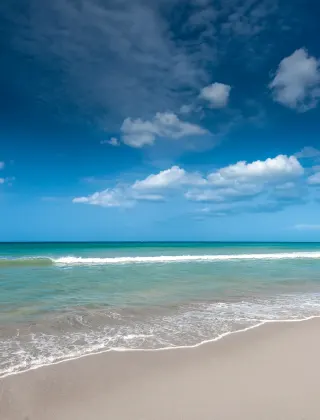
Nilaveli is approximately 16 to 20 kilometres north of Trincomalee town, depending on which part of the beach you are on. It is a long, quiet strip of white sand backed by palms, with very little development relative to the beaches further south on either coast. The water is clear and calm in season. It is quieter than Uppuveli and the preferred base for Pigeon Island trips, which depart from directly in front of the beach.
If you want the beach experience itself without surrounding activity, Nilaveli is the better choice. If you want services and proximity to the town's temples and fort, Uppuveli is more practical. Many visitors spend a night or two at each.
Pigeon Island National Park
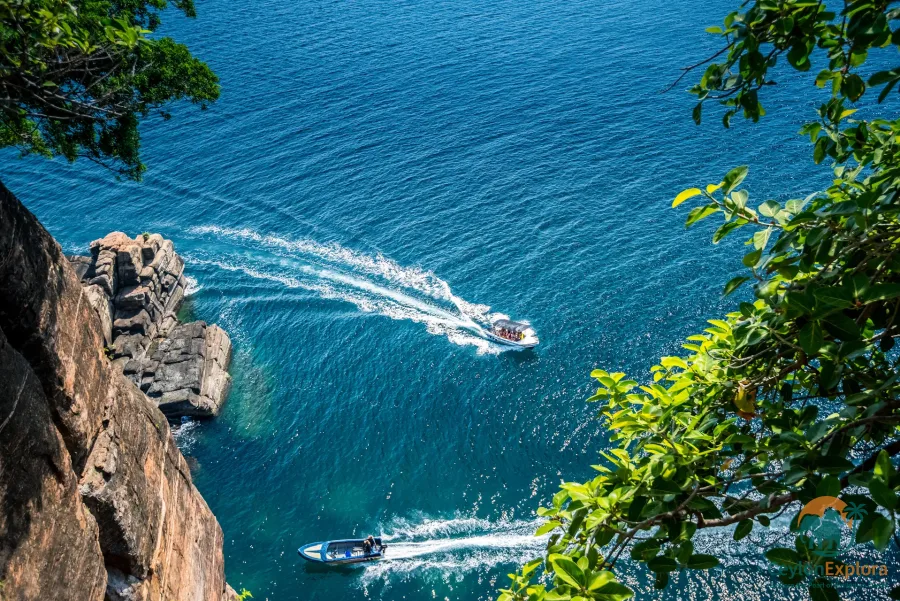
Pigeon Island is 1 kilometre off the Nilaveli coast. There are two islands: Large Pigeon Island and Small Pigeon Island. The boat ride from Nilaveli beach takes 10 to 15 minutes. Entry costs approximately USD 10 for foreign adults (verify current rates as fees are revised; boat hire costs approximately LKR 15,000 for a 6 to 8-seat boat, split among the group).
The reef on the main landing side of Large Pigeon Island has been significantly degraded in recent years, and some sections have little live coral left. The reef on the far side of the island, away from the main visitor area, is in better condition. Manage expectations about the shallow coral on the landing side, but go anyway: the blacktip reef sharks are the real reason to visit. Between 5 and 20 are typically visible in shallow water, circling the reef edge in 1 to 3 metres of water. They are small (under 2 metres), not aggressive toward snorkellers, and close enough to watch from the surface without diving. Green turtles and hawksbill turtles are also regularly seen. The fish life around the island remains good despite the coral degradation.
Rules: no chemical sunscreen (it damages coral), no touching or standing on coral, no fins in the shallower reef sections. Swimming is restricted to designated zones.
Koneswaram Temple
Koneswaram Temple stands on Swami Rock, a headland at the eastern tip of the Trincomalee peninsula rising approximately 120 metres above the Bay of Bengal. It is one of five ancient Pancha Ishwaram temples dedicated to Shiva in Sri Lanka, and one of the most significant Hindu pilgrimage sites on the island. The original temple, known historically as the Temple of a Thousand Columns, was patronised by Chola, Pandyan, and Jaffna kingdom rulers across centuries of recorded history.
The Portuguese destroyed it in 1624 under Captain-General Constantine de Sa. The temple was literally demolished and pushed off the cliff into the sea below, and the stones were used to build Fort Frederick on the same headland. In 1950, bronze statues and artefacts were unearthed during land excavations approximately 500 metres from the temple site. In 1956, writer Arthur C. Clarke and diver Mike Wilson found masonry, carved columns, and a Swayambhu lingam on the ocean floor beneath the cliff. Construction of the current temple began in 1952, with the gopuram completed in 1963.
Entry is free. Modest dress is required: shoulders and knees covered, shoes removed before entering the inner courtyard. The views from Swami Rock over the Bay of Bengal and the harbour below are among the more dramatic vantage points on the coast.
At the cliff edge stands a granite pillar associated with a local legend about a Dutch woman named Francina van Rhede, said to have jumped from the rock in 1687 after being abandoned by her lover. Historical records show she survived, later married, and died in Utrecht in 1731. The pillar is real; the story is not.
Fort Frederick
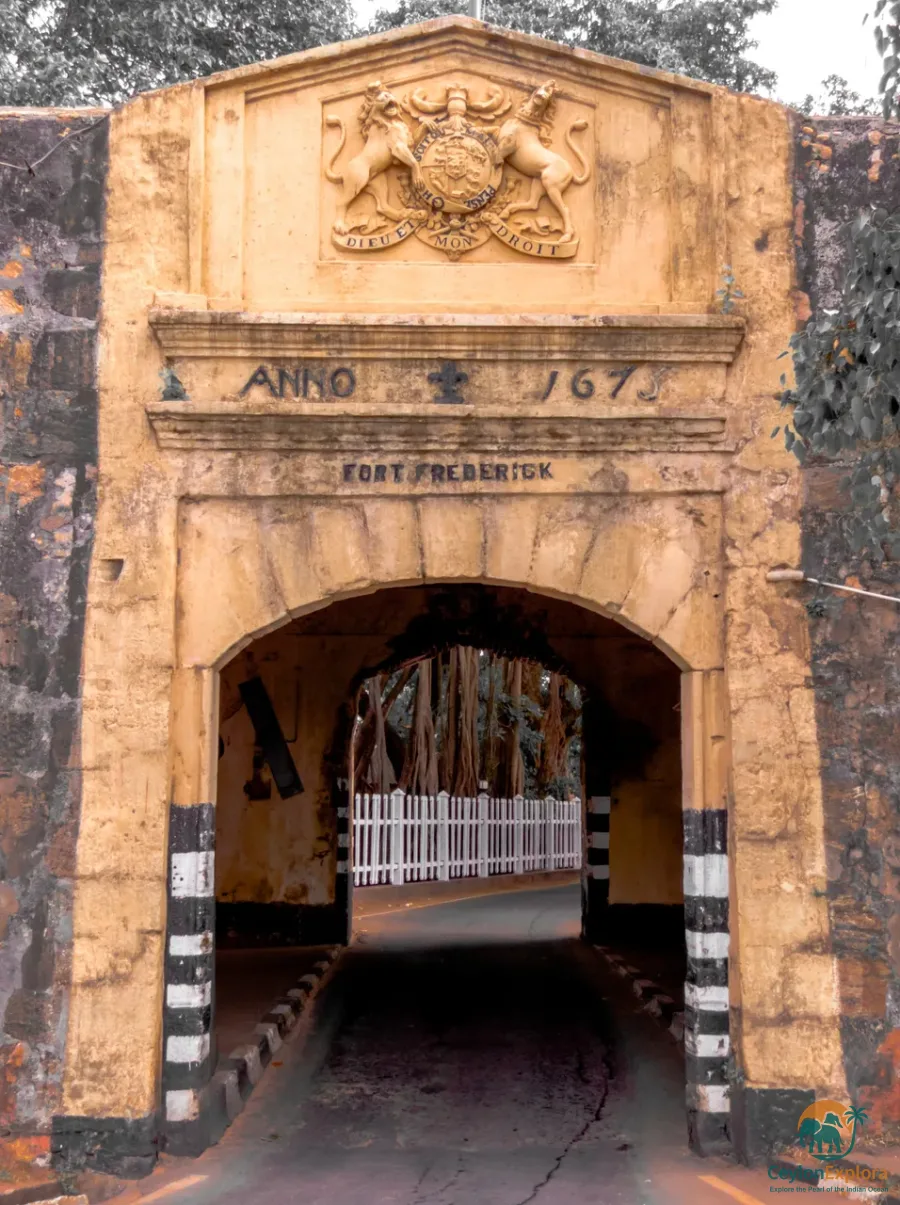
Fort Frederick occupies the same Swami Rock headland as Koneswaram Temple. The Portuguese completed the original fort in 1624, using stones from the demolished temple. The Dutch captured it on 2 May 1639. The original fort was demolished by Kandyan forces in 1643, and the Dutch built an entirely new fort on the same site in 1665, naming it Fort Fredrick. The British took it in 1782, lost it briefly to the French, and retook it in 1795. It remained a British garrison until independence in 1948.
The fort is still an active military base of the Sri Lanka Army's Gajaba Regiment, but it is accessible to visitors on foot. Walking through it takes 30 to 45 minutes. The fort contains colonial-era cannons along the ramparts, spotted deer that wander freely under the banyan trees (a genuine curiosity), and Wellesley House, a Georgian-style colonial building where Arthur Wellesley stayed before he became the Duke of Wellington. The building is not open inside. Entry to the fort is free.
Whale Watching
The deep ocean trenches off Trincomalee's coast make it one of the most consistent locations in the Indian Ocean for whale sightings from May to September. Blue whales are reliably seen June through September; sperm whales appear throughout the season, particularly earlier in the window. Bryde's whales and spinner dolphins are also regularly seen in these waters.
Trincomalee whale watching is significantly less crowded than Mirissa. Fewer boats go out, the experience is quieter, and operators typically combine the whale watching trip with a snorkel stop at Pigeon Island. Book through a guesthouse or established dive operator rather than an unsolicited beach tout.
Getting to Trincomalee
The distance from Colombo is approximately 257 kilometres. By private car the drive takes 5 to 6 hours via Dambulla and Habarana, and it is the route that makes the most of the journey: you can stop at Sigiriya, Dambulla or Minneriya on the way and arrive rested with your luggage handled. This is how most of our guests travel it. For travellers on a tight budget, an overnight train departs Colombo Fort around 21:30 and arrives around 05:30, and direct buses take approximately 7 hours.
From Anuradhapura the drive takes 3 to 3.5 hours, a comfortable same-day transfer with a driver. From the east coast's other main destination, Arugam Bay, the road connection is long and indirect: allow 4 to 5 hours by car via Ampara.
Combining Trincomalee with the Rest of Sri Lanka
Trincomalee works well at the beginning or end of a Sri Lanka itinerary rather than in the middle, because the road connections to the Cultural Triangle (Sigiriya, Anuradhapura, Polonnaruwa) are manageable. Anuradhapura is 3 to 3.5 hours; Sigiriya is about 3 hours. A practical itinerary runs Colombo to the Cultural Triangle, then to Trincomalee for the beaches, then south by road to Ella or Arugam Bay, then back to Colombo via the south coast.
If you want a driver for the Cultural Triangle and east coast loop, or need the Pigeon Island entry fees and logistics handled in advance, the team at CeylonExplora can arrange it. Get in touch to plan the route.



From Fellow Travellers
Comments
No comments yet
Been here, or planning your own trip? Share your experience below and help the next traveller.
Leave a Comment
Comments are reviewed before publishing. No links, please. Email is optional and never shown.